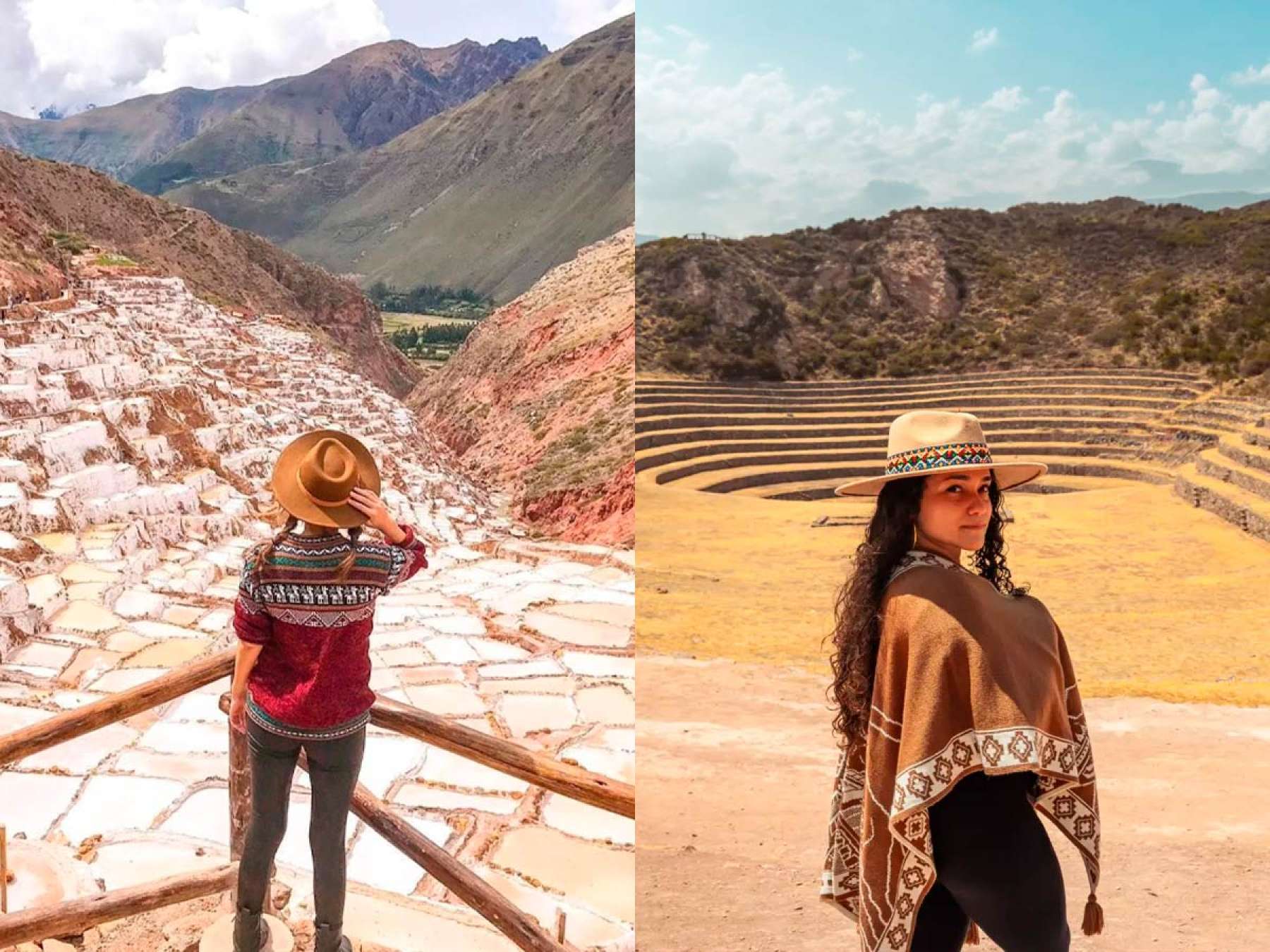
Northwest of Cusco, on the plateau overlooking the Sacred Valley of the Incas, are two of the region's popular sites: the Salt Mines of Maras and the Agricultural Terraces of Moray. Although they are usually toured on the same trip, each one is different; while the salt mines feature thousands of saltwater pools that have used a natural spring since pre-Inca times, Moray is a set of circular terraces that the Incas used as an agricultural experimentation center. They are separated by just a few kilometers, which makes it possible to visit them on the same day.
Both are part of the same corridor that the Incas organized around crop farming, trade, and land management at different altitudes, and thanks to their popularity, this is the reason why most people who travel to Cusco end up asking how to get to "Maras and Moray" as if they were a single destination.
In this blog we will get to know each of these sites and their importance within Inca history, how to get there from Cusco, how much the entrance fee is, and what the best time of day and year to visit them is.
About the Sacred Valley
The Sacred Valley of the Incas stretches along the Urubamba river, north of the city of Cusco, between Pisac and Ollantaytambo. It concentrates some of the most visited archaeological sites and towns in the region, and it is the base from which most travelers organize their trip to Maras and Moray.
Fact: Unlike Cusco (3,399 m.a.s.l.), the Sacred Valley drops down to 2,790 m.a.s.l. along 60 km of route. This lower altitude is the reason for its famous warm and welcoming weather.
Main sites that make it up
- Pisac: Craft market and archaeological complex on the mountain.
- Ollantaytambo: Inca fortress combined with a town that keeps its original urban layout.
- Chinchero: Colonial church built on Inca foundations and traditional textile workshops.
- Urubamba: Midpoint between the destinations, it serves as a resting place.
- Maras and Moray: Old salt mines next to a circular agricultural terrace laboratory.
For the Incas, this area was not just a place to pass through; the valley offered fertile land and warmer weather, which made it a key space for crop production. At the same time, several of its sites had a religious or ceremonial function, as is the case of temples and shrines spread along the route.
This mix of agricultural and religious use explains why it is still called "sacred" today and why it concentrates so many archaeological sites in a relatively small area.
Why is it still the tourist hub of the region?
Along with the city of Cusco and Machu Picchu, the Sacred Valley is one of the three hubs that concentrate most of the tourist tours in the region. Most tours to Maras and Moray start from Cusco or from a town in the valley, and they are usually combined with a visit to one or more of the sites mentioned above, either on the same day or on a multi-day tour.
What are the Maras Salt Mines and the Moray Terraces?
Maras and Moray are two independent sites located a few kilometers from each other, in the upper part of the Sacred Valley. Although each has a different purpose (one linked to salt extraction and the other to agricultural experimentation), their geographic closeness has made them become a joint destination over time within tours of the Cusco region.
Location and distance between both sites
- They are located about 50 km northwest of the city of Cusco.
- The distance between the Maras Salt Mines and Moray is about 7 km.
- Both belong to the Maras district, in the Urubamba province.
Maras Salt Mines
The Maras Salt Mines are a group of saltwater pools built on the slope of the Qaqawiñay hill, using an underground salty water spring that comes out at the top of the site. The water is distributed among the pools, and by evaporating under the Andean sun it leaves behind the salt that is gathered by hand.
Origin and use since pre-Inca times
- Salt mining in the area goes back before the Inca period; several sources place its origin in pre-Inca communities that already used the spring.
- During the Tahuantinsuyo, the salt produced here was a key item for trade with communities from the jungle, the high plateau, and the central highlands.
- Today, the pools are still worked by families from the local communities, who keep the traditional mining system going.
How does salt mining work?
The saltwater that comes out of a natural spring at the top of the complex is channeled into the pools, where it stays exposed to the sun. With evaporation, the salt solidifies on the surface and on the walls of each pool. Later, each pool is worked by a specific family or community, which cleans it and harvests the salt on a regular basis.
A special detail: A part of the salt produced in Maras has a pink color, the result of the minerals present in the spring water. This type of salt is sold both locally and for export, and is usually sold at the site or in local markets.
Moray Terraces
Moray is a group of circular terraces built by the Incas in three natural depressions of the land, shaped like stepped amphitheaters. Unlike other terraces in the Sacred Valley meant directly for farming on slopes, the circular layout of Moray has a different purpose: to work as an agricultural research space.
Origin and function as an Inca agricultural lab
- The biggest depression has about 12 circular terraces, with an approximate depth of around 100 meters.
- Each platform has its own walls and irrigation and drainage systems.
- It is estimated that this design allowed growing a wide variety of plant species, possibly testing seeds in different conditions before taking them to other parts of the empire.
How did the system work?
The stepped and circular shape creates a temperature difference between the top terrace and the bottom one of each depression. This microclimate variation would have allowed the Incas to simulate different altitude and weather conditions in a single place. Finally, the irrigation systems distributed the water among the levels, preventing erosion and keeping the moisture needed for farming.
A special detail: The temperature difference between the highest and lowest point of each depression can reach several degrees, which explains why Moray is thought of as a possible agricultural research center rather than a regular farming space.
How to get there from Cusco?
There are three ways to get to Maras and Moray from Cusco, and the choice depends on available time, budget, and whether you prefer to organize the trip on your own or leave it in the hands of an agency.
On an organized tour
This is the most used option by those who visit Cusco for a short time or prefer not to worry about transport logistics. The tour includes hotel pickup in Cusco, private or shared transport, a guide during the visit to both sites, and usually a return trip to the city.
It is usually combined with other points of the Sacred Valley (like Chinchero or Urubamba) within the same trip, depending on the booked itinerary. It is the simplest alternative, though also the most expensive.
On your own
In this option you take care of the logistics, you will start from Cusco where you take a shared taxi (colectivo) heading to Urubamba, using Pavitos Street as a reference.
The shared taxi leaves you at the road junction with the turnoff towards Maras, from that point, you hire a local taxi to get to the Maras Salt Mines and, if needed, continue to Moray. It is the cheapest option, but it requires more time and coordination than an organized tour.
Entrance price and tourist ticket
Access to Maras and Moray is paid separately, since they correspond to different tickets.
Entrance to Moray
Moray does not have its own ticket; it is only accessed with the Cusco Tourist Ticket, in one of these options:
| Type | Valid for | Includes | Foreigners | Peruvians |
|---|
| Partial Ticket – Circuit III (Sacred Valley) | 2 days | Moray, Ollantaytambo, Pisac, and Chinchero | S/70 (~US$20.70) | S/40 (~US$11.80) |
| General Comprehensive Ticket | 10 days | 16 attractions in Cusco and the Sacred Valley | S/130 (~US$38.50) | S/70 (~US$20.70) |
If the traveler only plans to visit Moray along with the other three sites of the Sacred Valley, Circuit III is the best-adjusted option. The Full Ticket is only convenient if you plan to visit several of the 16 included attractions.
Entrance to the Maras Salt Mines
The Maras Salt Mines are not included in the Tourist Ticket. Entry is managed directly by the local community and is paid only in cash, in soles, at the control booth itself:
| | Foreigners | Peruvians |
|---|
| Entrance | S/20 (~US$5.90) | S/15 (~US$4.40) |
Best time to visit Maras and Moray
The experience in Maras and Moray changes quite a bit depending on the time of year and the time of day you visit, mostly due to the state of the salt ponds and the number of visitors at the site.
- Dry season (May to October): This is the best time to visit both places. In Moray you will find clear skies and dry trails, ideal for walking, even though the grass on the terraces looks more yellowish. In Maras, you will find clear skies and a cool climate ideal for exploring and taking pictures, plus it is when the salt is actively harvested and processed.
- Rainy season (November to April): The landscape becomes greener and more colorful in Moray, although the trails can get slippery and there is more fog. In Maras, the rain mixes with the water in the ponds and reduces the harvesting activity, so they look less white.
In both cases, this matches the general weather pattern of the Cusco region, so those who are already planning the trip based on the dry or rainy season for the rest of the Sacred Valley do not need to adjust extra dates just for Maras and Moray.
Frequently asked questions about Maras and Moray
- Can you visit without a tour?
Yes, both places can be visited on your own. You can get there by shared taxi, taxi, or rental car from Cusco (or from Urubamba/Ollantaytambo if you are coming from the Sacred Valley). You do not need a guide, although hiring one at the entrance helps you better understand the history of the place.
- How long does the visit take?
Counting both sites, between 2 and 3 hours is enough if you go on your own (1 hour in Moray, 1 hour in Maras, plus travel time). Organized tours usually last from 3 and a half hours to 6 hours, since they include hotel pickup and sometimes other stops like Chinchero or Misminay.
- Can you buy salt right there?
Yes, in the Maras salt mines there are stands run by the local community members where pink salt is sold in different presentations (bags, jars, salt cosmetics), at quite affordable prices.
- How much is the entrance fee?
Moray is visited with the Cusco Tourist Ticket (partial or general), which is around S/70 for the partial circuit. The entrance to the Maras salt mines is separate and paid apart, usually between S/10 and S/20 for foreigners (it is a good idea to bring cash in soles, since they do not always take cards).
- How far are they from Cusco and how long does it take to get there?
They are a little over an hour by car from Cusco (about 45-50 km). Maras and Moray are a few minutes apart from each other, making it easy to combine them on the same trip.
- What altitude are they at and is there a risk of altitude sickness?
Moray is at about 3,500 meters above sea level and Maras is at a similar altitude. If you just arrived in Cusco (3,400 meters above sea level), it is recommended to get used to the altitude for one or two days before this trip.
- Is it suitable for children or older adults?
Yes, both sites have trails and viewpoints you can access without major physical difficulty. In Moray, if you want to walk down to the center of the terraces, there is a short walk, but with a slope; in Maras the walk along the edges of the ponds is flat.
- Can it be combined with other places in the Sacred Valley on the same day?
Yes, it is common to combine them with Chinchero, Ollantaytambo, or Pisac on full-day tours, although if you prefer to go slowly, the ideal is to dedicate a separate morning or afternoon to them.

 +51 84 226 547
 +51 912 891 560
 Av Tupac Amaru PP-10B, Santiago, Cusco, Peru
  info@salkantaytrekmachu.com
 www.salkantaytrekmachu.com