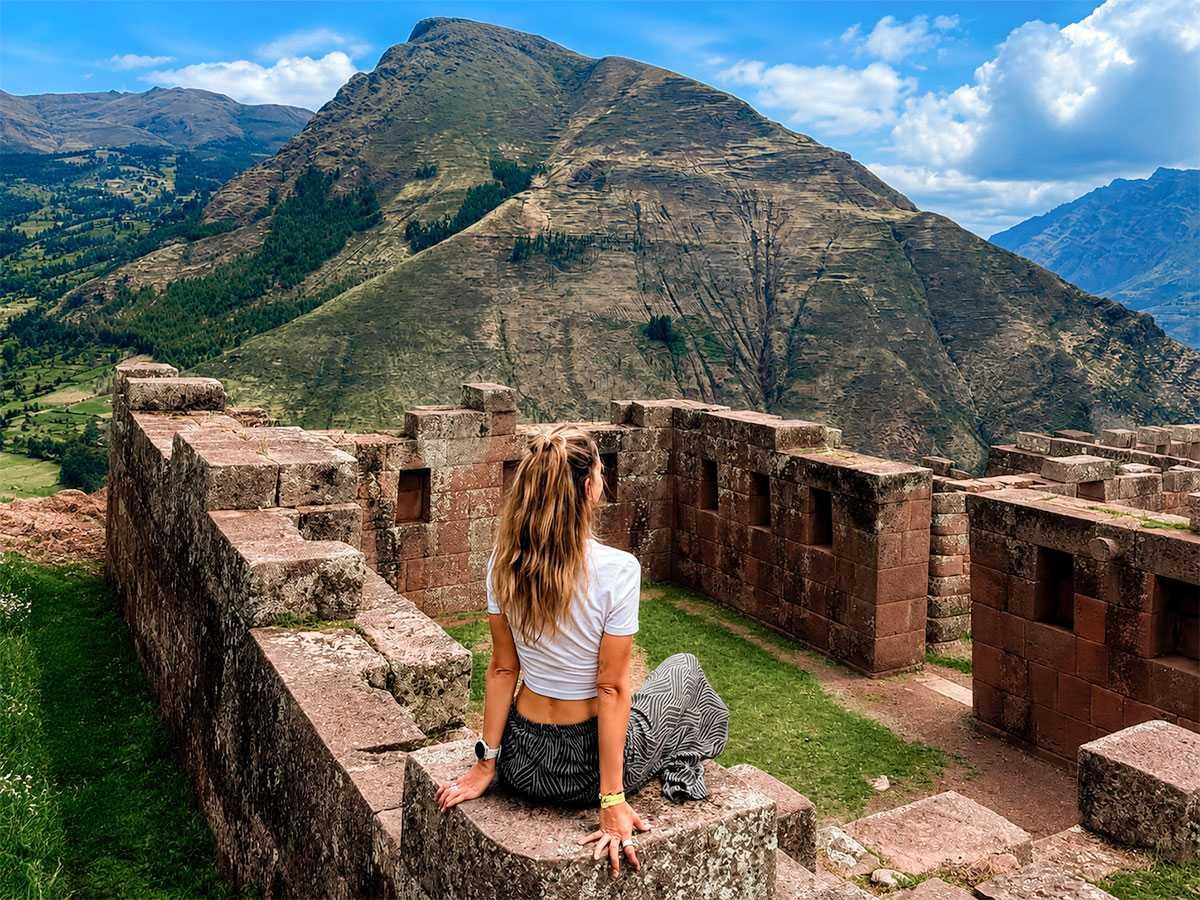
The Sacred Valley of the Incas, near the city of Cusco, is home to several of the most important archaeological complexes in the region, with Pisac being one of the most important and biggest. Located strategically on a mountainside that overlooks the modern colonial town, this site is a key example of Inca engineering and their ability to blend architecture with the landscape.
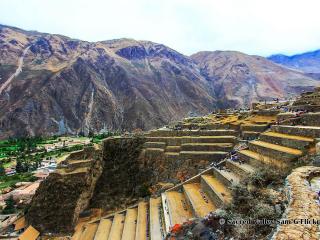
The Pisac National Archaeological Park covers an area of approximately 4 square kilometers. It is made up of a group of different archaeological sectors connected by paths, aqueducts, and walls. The most notable feature of the site is its impressive and vast system of andenes (agricultural terraces), which adapt to the steep mountainside. In addition to its farming function, the complex includes a ceremonial center, an urban (residential) sector, and the largest known Inca cemetery in the region.
This guide is designed to provide history and important facts. Below, we will learn all about Pisac and its archaeological center, as well as its history and its culture.
Location
The archaeological site of Pisac is located about 32 km east of the city of Cusco, in the Sacred Valley of the Incas.
Pisac Archaeological Park
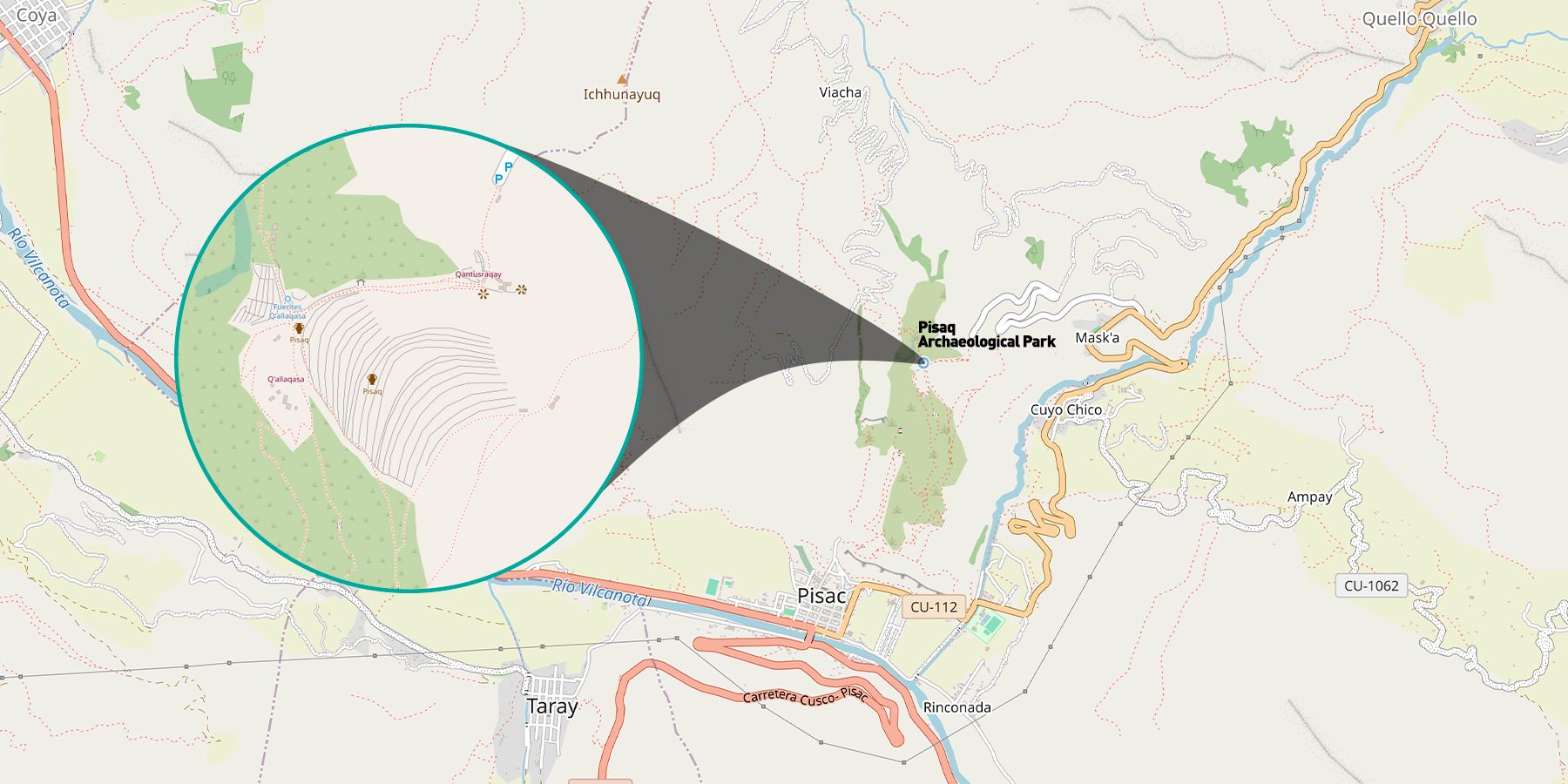
How to get from Cusco to the town of Pisac
There are two main ways to get to the town of Pisac from Cusco:
- By organized tour: The most comfortable option is to hire an agency that does a tour through the Sacred Valley, which usually includes direct transport to the archaeological site along with other stops in the valley.
- By public transport: There are minivans that leave from Puputi Street in Cusco heading to Urubamba, with frequent departures (about every 15 minutes). The trip to the town of Pisac takes about 45 minutes to 1 hour.
How to get from the town of Pisac to the archaeological site
Once in the town, there are several ways to go up to the archaeological site, which is located at the top:
- On foot: There is a path going up that connects the town with the back of the archaeological site, taking about 1 hour and 30 minutes. It is a hard walk because it is steep, but it has good views of the valley on the way.
- By taxi: The fastest way, with a trip of about 10 minutes to the main entrance.
- By combi or shared transport: A cheaper choice than a taxi, with a travel time of around 30 minutes.
Pisac, history and important data
The archaeological park of Pisac is located on the Apu Inti Huatana Hill, in the town of the same name, in the province of Calca, 32 km from the city of Cusco. The town of Pisac is at 2,950 meters above sea level, while the archaeological site is located considerably higher, at about 3,300 meters above sea level.
Its impressive buildings make it one of the most important Inca jewels credited to the Inca Pachacutec, and the site is divided into two clearly different areas: the high part, of Inca origin, houses the archaeological complex itself; the low part, in the valley, belongs to the current town, founded in the colonial period.
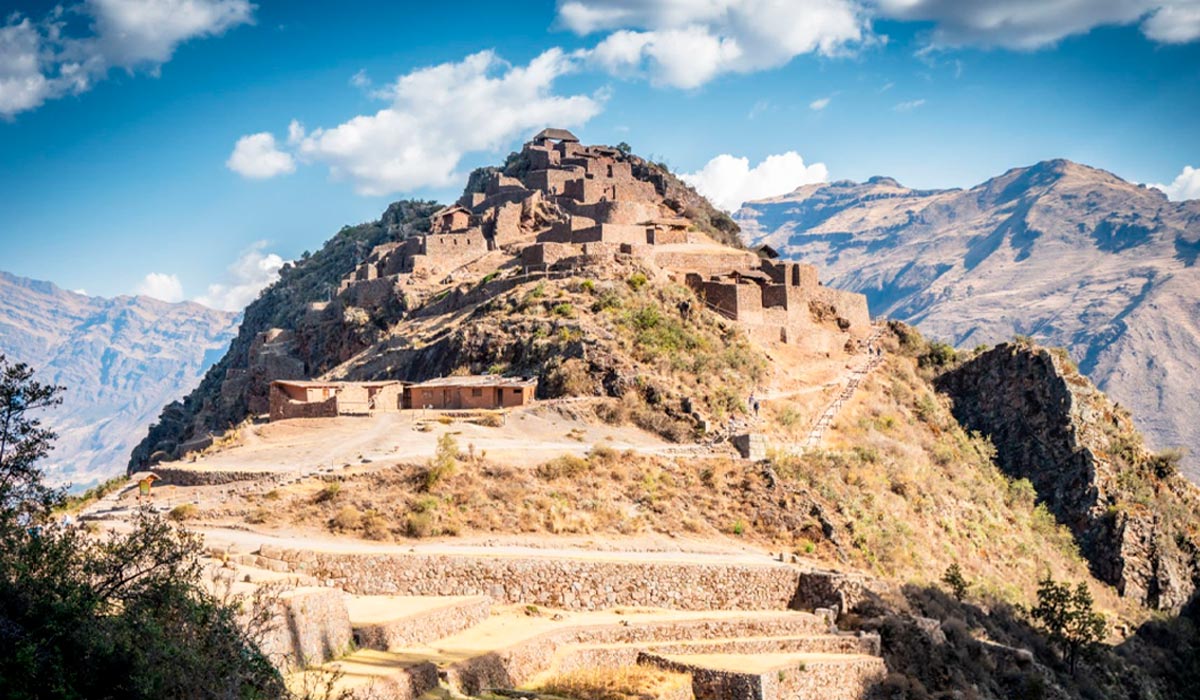
Archaeological park of Pisac
The Intihuatana: an accurate astronomical observatory
Pisac is known as one of the main Inca astronomical observatories, and the central part of that function is its Intihuatana ("place where the sun is tied", in Quechua). It is a precisely carved stone that worked as a sundial and astronomical marker: depending on the position of the shadows cast on the stone throughout the year, the Incas could exactly determine the solstices and equinoxes.
This information was key for the farming calendar, since it allowed them to know exactly when to start planting and harvesting, something essential in a civilization whose economy depended highly on high-altitude farming. The Intihuatana of Pisac is, along with the one in Machu Picchu, one of the few that survived relatively intact to the passage of time and colonial destruction.
The Spanish invasion and the Tanpumachay cemetery
According to historians, in the 16th century Pisac was invaded by the Spanish, which caused its people to flee. As a result, the main monuments of the site were damaged, and the Inca cemetery of Tanpumachay was destroyed and looted. The size of this loss is hard to measure: it is estimated that this cemetery came to contain more than 10,000 chullpas (tombs), which made it the largest known Inca cemetery. A large part of that funeral heritage was completely lost during the colonial looting.
The defensive triangle: Cusco, Pisac and Piquillacta
One of the most interesting facts about Pisac is its strategic position within the defense system of the Inca empire. Together with Cusco and Piquillacta, Pisac forms an equilateral triangle of about 33 kilometers per side. It is believed that this layout was not an accident: the Incas planned Pisac as part of a territorial control system meant to protect the imperial capital from possible attacks coming from the east, where rival towns like the Chancas were located, one of the main historical enemies of Inca Cusco before and during the growth of the empire. Pisac, along with other fortresses in the region, acted this way as a first line of watch and defense against these threats.
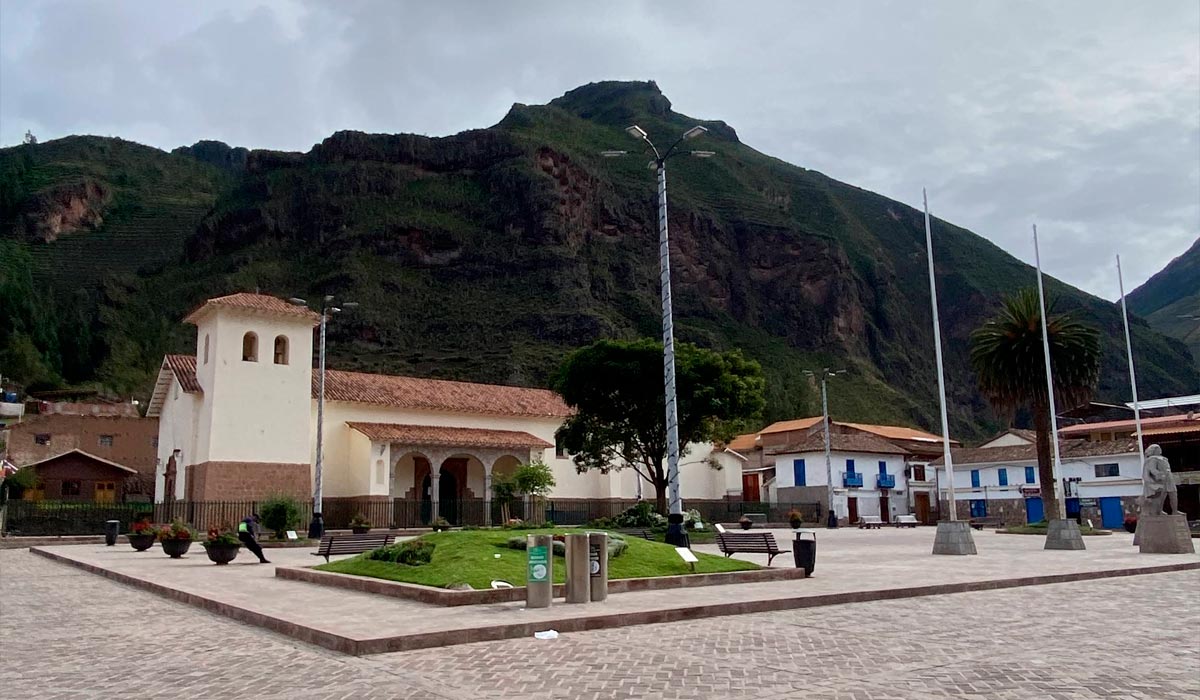
Town of Pisac
Attractions
Group of Acchapata Platforms
Just 200 meters up from the Pisac town square stands a beautiful set of platforms. This group is made up of 40 platforms forming a kind of triangle with the vertex pointing downwards, that is, the smallest platform is the first that the visitor can see when they start to ascend.
Torreones or Pucaras
In the citadel of Pisac we can count more than twenty towers and they are of two types: the dwelling towers and the watchtower towers; The first ones are conical enclosures associated with water channels built with well-carved and assembled pieces, these look like pulpits attached to the mountain. The watchtower towers are beautiful elevations, with a conical tendency, they are not enclosures, their texture is solid and their interior compact mass plus their portion is flat surface. The most important in its location is Qoriwayrachina.
Intiwatana neighborhood
It is the central neighborhood, home to temples and palaces, with a higher architectural quality, greater beauty in its walls, the enclosures are larger in relation to those of other neighborhoods. It has 3 levels to gain aesthetics and comfort, modulated buildings directed towards the main valley. In this place we can find: The central enclosure, the Intiwatana, the altar carved in a volcanic breccia, groups of liturgical sources, alleys and patios.
Tianayuc neighborhood
It is known as Tianayuc, which translates as "that has a seat" since in the interior patio there is a kind of sofa for two people, with a backrest and elbow pads made of stone. This neighborhood is small, with rooms whose doors overlook a central patio, plus an almost destroyed tower that dominates a good part of the K'itamayu ravine.
K'alla Q'asa neighborhood
It is the largest of the neighborhoods of the Inca city of Pisac, built on the top of the mountain, the highest altitude of all the enclosures, its enclosures move on an inclined plane in a descending way towards the North. It has many rooms, steep slopes, towers, a short tunnel 3 meters long; This neighborhood has impressive ravines on its sides.
Pisaq'a neighborhood
It is located on the Chongo ravine, two hundred meters away from the Intiwatana neighborhood and at a lower altitude. This neighborhood was built by lowering the original ground level until modulating a plain. The plan of this neighborhood is semicircular obeying the shape of the mountain, this set consists of 23 enclosures built with amazing order.
Qanchis neighborhoodRaqay
This neighborhood has many buildings, the houses are made of medium and small stones, the plane of the complex is inclined that reaches the hillside where the Chongo stream is. The entire neighborhood is like a sentinel controlling the northeastern side of the city of Pisac.
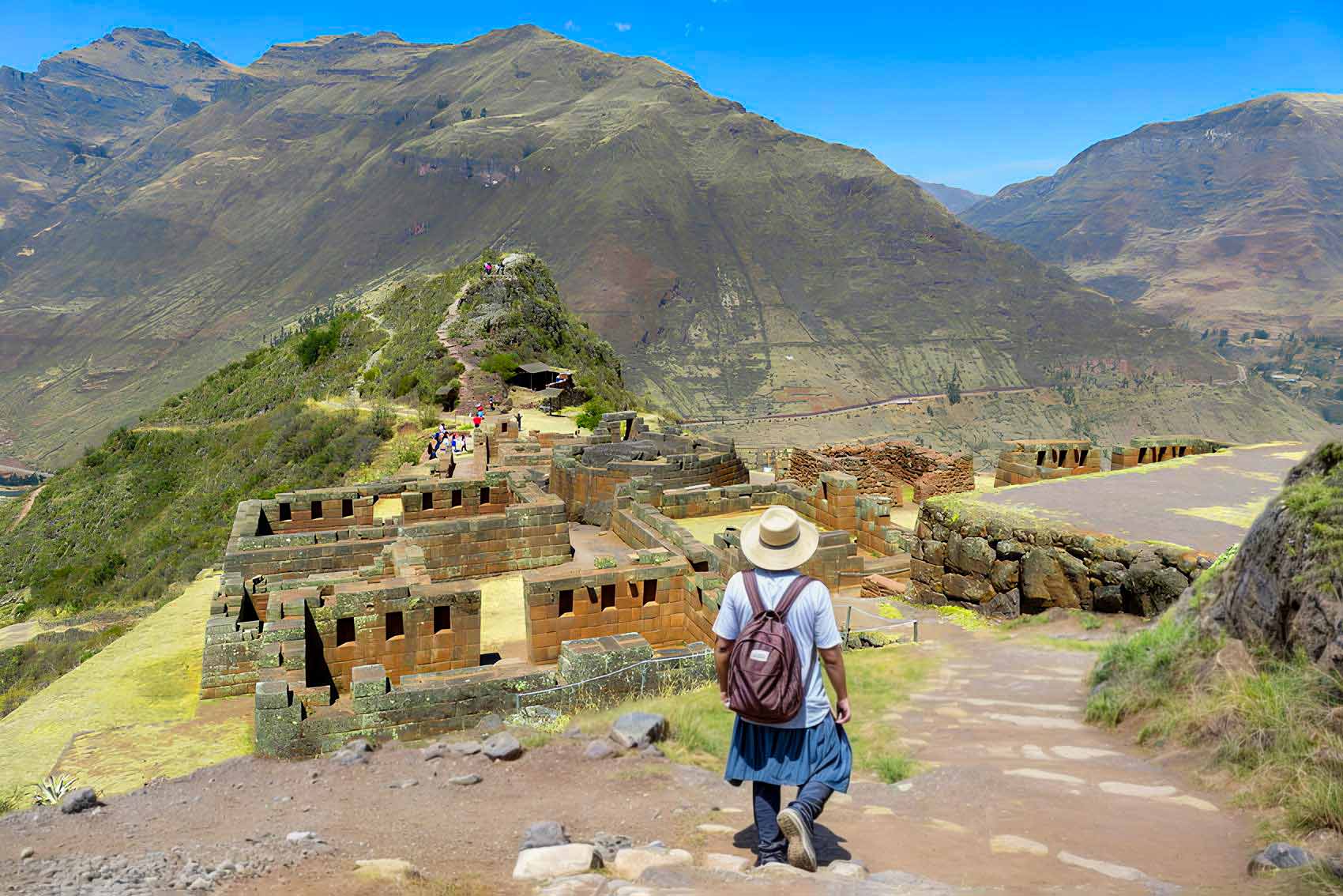
How to get to Pisac from Cusco?
This town is located 1 hour from the city of Cusco. To get to this amazing place, you must follow the road that leads to Sacsayhuaman, through public transport that you will find on Puputi street through the Historic Center of the city of Cusco.
Once you have arrived at the town of Pisac, you have two options to get to the archaeological park, one of them is taking a walk of approximately 1 hour 30 minutes, and another option is to use public transport (30 minutes).
This picturesque town presents us with a challenge for the future of the new generations, to establish a city that preserves its cultural identity based on the principles of our ancestors.
Schedule
The Hours of Entry from 7:00 a.m. to 6:00 a.m.
The entrance cost is included in the Tourist Ticket
Frequent questions
When was the Pisac district created?
Officially, the district was created on June 21, 1825, by decree issued by the Liberator Simón Bolívar.
What does the word Pisac mean?
It comes from the Quechua word pisaq or p'isaqaq, which means partridge or bird, the same shape as the area for which it is very characteristic.
In addition, this term has a special importance, because it refers to spirituality, with the mystical, with the spiritual values that the human being develops.
How much does the trip from Cusco to Pisac cost on my own?
If you want to go to Pisac on your own, you must take a public transport (minivan) on Puputi street, located just 15 minutes from the city center. This trip costs 6 soles and takes approximately 1 hour.
Can I walk up from the town of Pisac to the archaeological site?
yes, the walk will approximately take you almost 1 hour.
Where to buy the Cusco Tourist Ticket?
You can buy the Cusco Tourist Ticket on Avenida El Sol 103, or at the entrance of the archaeological center.
Where to buy a tour to Pisac?
You can purchase a tour to Pisac and the entire sacred valley here.
How long does it take to tour the entire archaeological site?
The Pisac archaeological site is huge. Going through all its neighborhoods, buildings and roads can take 2 hours or even more.
Is the visit dangerous?
No, the archaeological site of Pisac has well-defined paths with notices for tourists.
Is Pisac open all year?
Yes, the archaeological site remains open to tourists every day of the year except in cases of emergencies (natural disasters, strikes, etc.).
At what time is it recommended to visit it?
We recommend that the visit can be made between the months of May to October, which is the dry season (there is not much rain).

Best Tours in Peru
Many are the routes that take you to Machu Picchu, but none is like the Inca Trail Tours, the most famous pedestrian path in the Americas. After flying from the capital of Perú, Lima, you will arrive in Cusco to walk for four days along a path through forests and dense fog, millenary stone steps and discovering the ruins of ancient fortifications and Inca cities, and all the time enjoying majestic views.

 +51 84 226 547
 +51 912 891 560
 Av Tupac Amaru PP-10B, Santiago, Cusco, Peru
  info@salkantaytrekmachu.com
 www.salkantaytrekmachu.com