The best alternative hike to the traditional Inca Trail is the Salkantay Trek to Machu Picchu, ranked as one of the wonderfully scenic hikes in the world boasting a great diversity of ecosystems. During the total length of the hike, you will be amazed by the surrounding scenery, food crops, medicinal plants, bamboos, and colorful flowers like begonias, orchids, etc. Traversing the Salkantay Trail to Machu Picchu in 5 Days/ 4 Nights leads you through the most scenic and biodiverse routes with different ecosystems such as the Alpine area, tropical high jungle, cloud forest, etc. The Andean people live off the land, farm cattle, poultry, and guinea pigs, and keep practicing their old traditions. The Salkantay Mountain soars to 6,271 m/20,700 ft considered by the local people a protector mountain god (Apu), and "Guardian Spirit of the Jungle". Enjoy the striking views of snow-topped Mt Salkantay towering at the head of the valley, and admire views of the valley mountains with remote Andean villages located at the base of them. On the penultimate day of the tour, you will be astounded by the view of Machu Picchu from the Inca site of LLactapata located at the back of Machu Picchu, the Inca sanctuary of Machupicchu. Finally, you will explore the Inca sanctuary of Machupicchu, one of the seven wonders of the world.
Sustainable Tourism: At Salkantay Trek Machu, we are happy to promote and practice sustainable tourism and support local communities.
Difficulty Hike: 3 Demanding.
Age Requirements: 4+ / All travelers under age 18 must be accompanied by an adult.
Staff: A Salkantay Trek Machu representative in Cusco and a professional Tour Guide, Cook, and Horseman with horses.
Accommodation: 3x Campsite, 1x Hotel.
Meals: 4x breakfast, 4x lunch, 4x dinner, 3x afternoon hot beverage
Transportation: Private transportation, train ticket return to Cusco.
Camping Equipment: A double tent, Inflatable sleeping roll mattress, feather sleeping bag (-5 grade), a pair of hiking poles, inflatable pillow camping, and others (More details, please check the section Included).
Day 01: Cusco - Mollepata - Soraypampa - Humantay Lagoon
Day 02: Soraypampa - Salkantay Pass - Wayraqmachay – Colpapampa
Day 03: Colpapampa – Sahuayaco Beach – Lucmabamba
Day 04: Lucmabamba - Llactapata - Hydroelectric - Aguas Calientes
Day 05: Aguas Calientes - Machu Picchu - Aguas Calientes - Ollantaytambo – Cusco

Sustainable Tourism | Be responsible towards Nature


The day starts with the pickup of the passengers at their respective accommodations between 04:30 and 05:00 hours. Later, the trip to the town of Mollepata begins, the route goes through the towns of Izcuchaca and Limatambo for about two hours, during the trip a stop is made to have a light breakfast. After breakfast, the transport continues the climb to Challacancha, which works as the official starting point for the Salkantay route.
In Challacancha, the meeting with the logistics team and the muleteers takes place. In this stage, the heavy luggage is handed over, allowing a strict maximum of 5 kg (personal belongings per passenger) to be transported on horseback. This allows starting the journey carrying only a light day backpack ("daypack"). The hike moves along an old path that follows the course of a small river through the mountain valley. After three hours of continuous walking, the expedition arrives at the Soraypampa base camp, located at 3,900 masl, where lunch is served.
In the afternoon, after resting at the camp, the 1 hour and 30 minute hike to Humantay Lake begins, located at 4,220 masl. Once at the lake, the guide provides the geographic facts of the ecosystem and time is given for the visitor to take photos of the landscape. After that, the group makes the descent back to the base camp in Soraypampa. Where you will spend this first night of the expedition inside the installed infrastructure of geodesic domes ("Sky Domes"), which provide greater thermal insulation against the low temperatures of the area. The day ends with the service of coca tea to stabilize body temperature and the corresponding dinner.

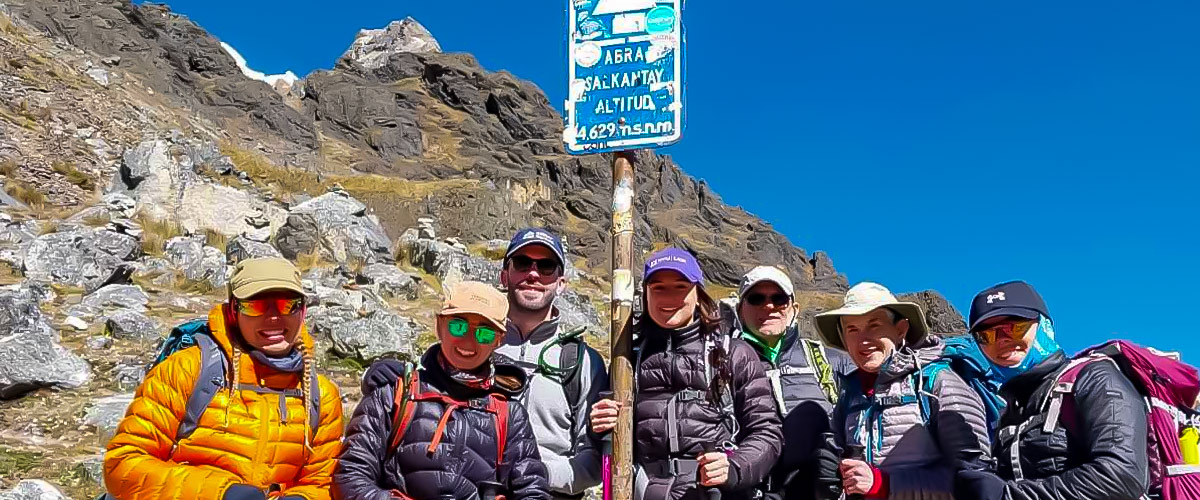
The day starts around 05:00 hours with a nutritious breakfast to get the energy needed for the longest section of the route. The hike starts from Soraypampa with a steady climb of three to four hours to the highest point of the journey: the Salkantay Pass, located at 4,650 masl. During this climb, you cross the areas of Salkantaypampa and Soyrococha, where it is possible to observe a small Andean lake. Upon reaching the pass, you have a direct view of the Salkantay, Humantay, Tucarhuay and Pumasillo snowy peaks, and the guide takes the moment to explain the tradition of the offerings that locals make to these mountains.
After time for photos and rest, a descent of about three hours begins along a winding and rocky path. This first downward section leads to the Huayracmachay sector, located at 3,800 masl, the designated place for lunch and free time to regain strength.
In the afternoon, the hike continues downward for an additional three hours. At this stage, the landscape undergoes a very noticeable change, leaving behind the freezing and rocky climate of the high mountain to progressively enter the cloud forest or jungle brow. This warmer and more humid environment allows you to start observing the typical flora and fauna of the Andean Amazon. Finally, the expedition reaches the Collpapampa camp, completing a total distance of 22 kilometers for the day. The night is spent in conditioned cabins at the site, closing the day with tea time and dinner.

The third day begins in the warmer environment of Colpapampa, an area where the transition to the cloud forest and the subtropical jungle becomes clear. After breakfast, an adventure of about five and a half hours begins, hiking through the Andean-Amazonian vegetation. The trail features moderate slopes with uphill and downhill sections. During the journey, the mild climate favors the observation of local flora, allowing you to see orchids, begonias, bromeliads, fruit tree plantations and various plants traditionally used for medicinal purposes.
The first part of the hike ends upon reaching the Playa Sahuayaco sector. At this point, a stop is made for lunch and some rest time. Taking advantage of the location, visitors participate in a demonstration activity (coffee tour) to learn about the process of growing, harvesting, and roasting the organic coffee produced in this region. Later, the route is resumed with a short final walk of about 30 minutes to reach the Lucmabamba camp, completing a total distance of 14 kilometers for the day.
Once settled in the private domes adapted to the jungle climate, the afternoon is free. Passengers have the option to take local transport to the town of Santa Teresa to visit and relax in the Cocalmayo hot springs (transport and hot spring entrance costs are not included in the package). Those who choose this activity must return to the camp around 18:00 hours to meet with the group, have tea, and end the day with dinner.

The day starts early to make the most of and enjoy a natural environment surrounded by rivers, waterfalls, and plantations of coffee, bananas, and avocados. After a good breakfast, a climb of about three hours begins, traveling along an original section of the ancient Inca Trail. The goal of this climb is to reach the Llactapata archaeological complex, located at 2,700 meters above sea level. At this point, the guide will share the history of the Inca buildings, and hikers will be able to enjoy one of the most awaited moments of the route: the first panoramic view of the back of the Machu Picchu citadel and the Huayna Picchu mountain in the distance.
After exploring the complex and taking photos, a descent of about two hours begins toward the Hidroelectrica sector, located at 1,800 meters above sea level, taking a break along the way to enjoy lunch. During this downhill section, you pass near an ancient carved stone known as Intihuatana, which was used by the Incas as a sundial and astronomical tool to mark the solstices and agricultural seasons.
Once at the Hidroelectrica station, the journey offers two options to reach the final destination of the day. The traditional option is to take a flat walk of about three hours following the path that runs parallel to the train tracks, surrounded by abundant Amazonian vegetation. The second option, for those who prefer to rest their legs, is to take the train optionally to the town (this ticket has an approximate cost of USD $39).
Upon arriving in Aguas Calientes (also known as Machu Picchu Town), the hiking expedition finishes its camping phase. The group will settle into a comfortable hotel to take a shower and rest. The afternoon is free to walk through the craft market or visit the town's hot springs; at night, the group will gather for a farewell dinner, where the guide will provide all the instructions and logistical details for the visit to the Wonder of the World the next morning.

The most awaited day of the trip arrives: the visit to the Historic Sanctuary of Machu Picchu, recognized as a UNESCO World Heritage Site.
Access to the citadel depends on the circuit assigned at the time of booking the 5-Day Salkantay Trek to Machu Picchu. There are three circuits, divided into a total of 10 routes. If you book in advance, we assign Circuit 2, Route A or B, which allows you to explore the entire Inca citadel; availability, however, is limited. If Circuit 2 is sold out, the next option is Circuit 3, Route B, which allows a visit to the lower section of Machu Picchu. If you book at the last minute, we may still find availability on Circuit 1, which offers a panoramic view of the citadel.
Breakfast is served at the hotel. For greater comfort during the tour, your main luggage stays stored at the accommodation, since entry to the archaeological site is only allowed with a small backpack containing the essential items for the day.
To reach the citadel, you take a shuttle bus up to Machu Picchu, an uphill ride of about 25 to 30 minutes. During the ride, you can admire the jungle and green mountains of Cusco's subtropical region.
Once you pass the entrance control at Machu Picchu, a guided tour begins, exploring the most important sectors, squares, and temples while learning about the history, architecture, and culture of this Inca citadel (este segmento dice "two and a half hours" y luego lo asocia solo a Circuito 2, pero tus datos verificados dicen Circuito 2 = 3 horas. Falta confirmar el número correcto). In addition, those who booked in advance can add an optional climb: Huayna Picchu Mountain (about 2 hours, included with Circuit 3) or Machu Picchu Mountain (about 3 hours, included with Circuit 1).
Finally, you return to the town of Aguas Calientes, where you have free time for lunch and to explore the area a little more. To conclude the 5-Day Salkantay Trek, you board the round-trip train to Ollantaytambo station, where tourist transportation is waiting to make the final transfer to your hotel in Cusco.
Meal budget: Please allow USD 20-30 for meals not included.

 +51 84 226 547
 +51 912 891 560
 Av Tupac Amaru PP-10B, Santiago, Cusco, Peru
  info@salkantaytrekmachu.com
 www.salkantaytrekmachu.com