
The Salkantay trekking is the most popular alternative hiking route to reach Machu Picchu. Named in honor of the Salkantay Mountain, the route extends through the Vilcabamba Mountain Range, northwest of the city of Cusco. Its location, relatively close to Cusco, makes it accessible by land transport and places it as a strategic starting point for this demanding Andean journey.
This hike is known for its ecological change and its high physical demand. The trail climbs quickly to its highest point, the Salkantay Pass, where extreme alpine conditions are experienced. Later, the path descends sharply toward the warm and humid cloud forest, this climate and altitude variability requires adequate physical preparation and, most importantly, mandatory prior acclimatization in the city of Cusco.
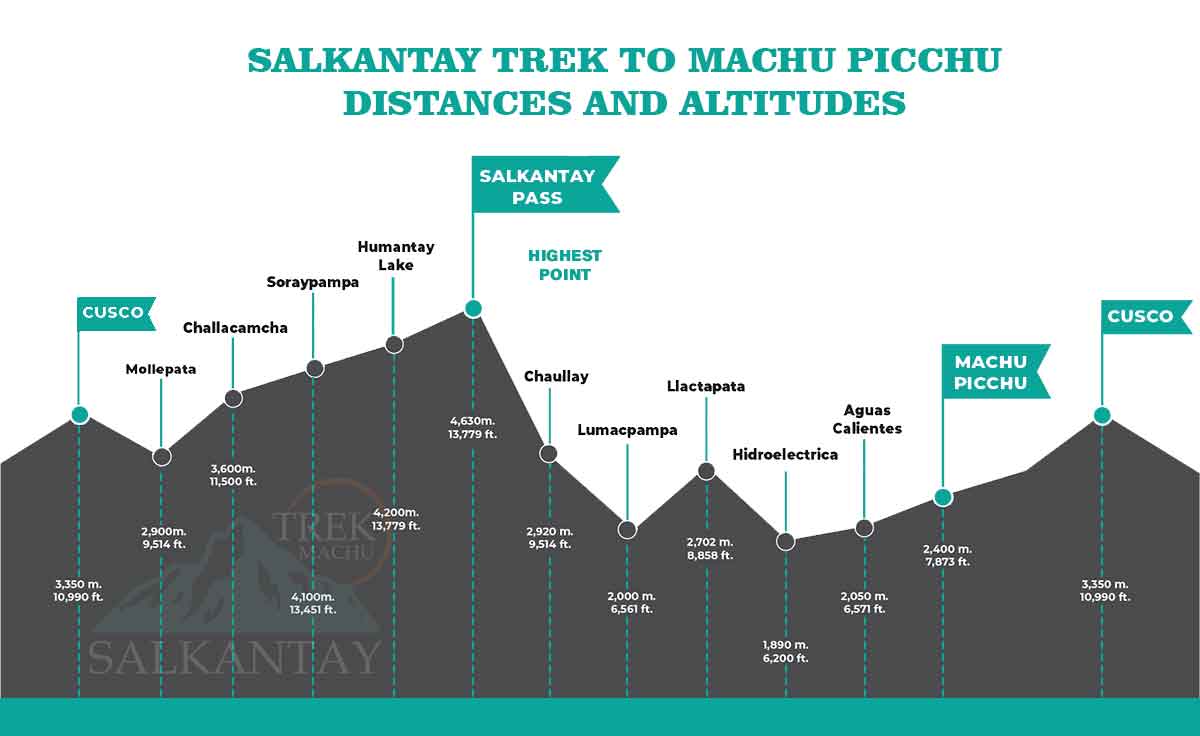
Join us and learn everything about the Salkantay trek, discover the three key factors that define this route: the total Distance that must be covered (approximately 74 km), the physical Difficulty Level of each day, and the maximum altitude that is reached.
Salkantay Trek to Machu Picchu passes through stunning landscapes varying from the cloud forest to the high mountains. Along the way you will see the fantastic views of the second-highest mountain in the Cusco, we are talking about the imposing Apu Salkantay ("Savage mountain" from Quechua) standing at 20,574' (6,271 m). This trek to Machu Picchu goes through unfrequented areas and combines culture and tradition with the incredible flora and fauna offered by Peru. You will be in the real Andes and in the perfect conditions to get a sense of life in the area. Now we present you the distances that you will hike during Salkantay Trek :
No matter the time of year, the trail cools at night (the altitude is more than 6000 m) until you reach Aguas Calientes. Bring a warm sleeping bag and dress in layers. A high-quality warm sleeping bag is essential. We recommend bringing your best sleeping bag if possible.
If you plan to rent a sleeping bag, consider bringing a silk liner for extra warmth and comfort. A four-season sleeping bag (or -10°C rating) is recommended for the winter months.
During other times of the year, a three-season sleeping bag (or -4°C / -5°C rating) should be sufficient, though this depends on individual tolerance to cold and should only be used as a guideline.
For the trip from Salkantay to Machu Picchu, we provide roll-up mats. However, for added comfort and warmth, thermal-style mattresses can be rented in Cusco. If you're traveling in winter and don't want to invest in a four-season bag, consider using a three-season bag with a liner and wearing additional layers.

 +51 84 226 547
 +51 912 891 560
 Av Tupac Amaru PP-10B, Santiago, Cusco, Peru
  info@salkantaytrekmachu.com
 www.salkantaytrekmachu.com


