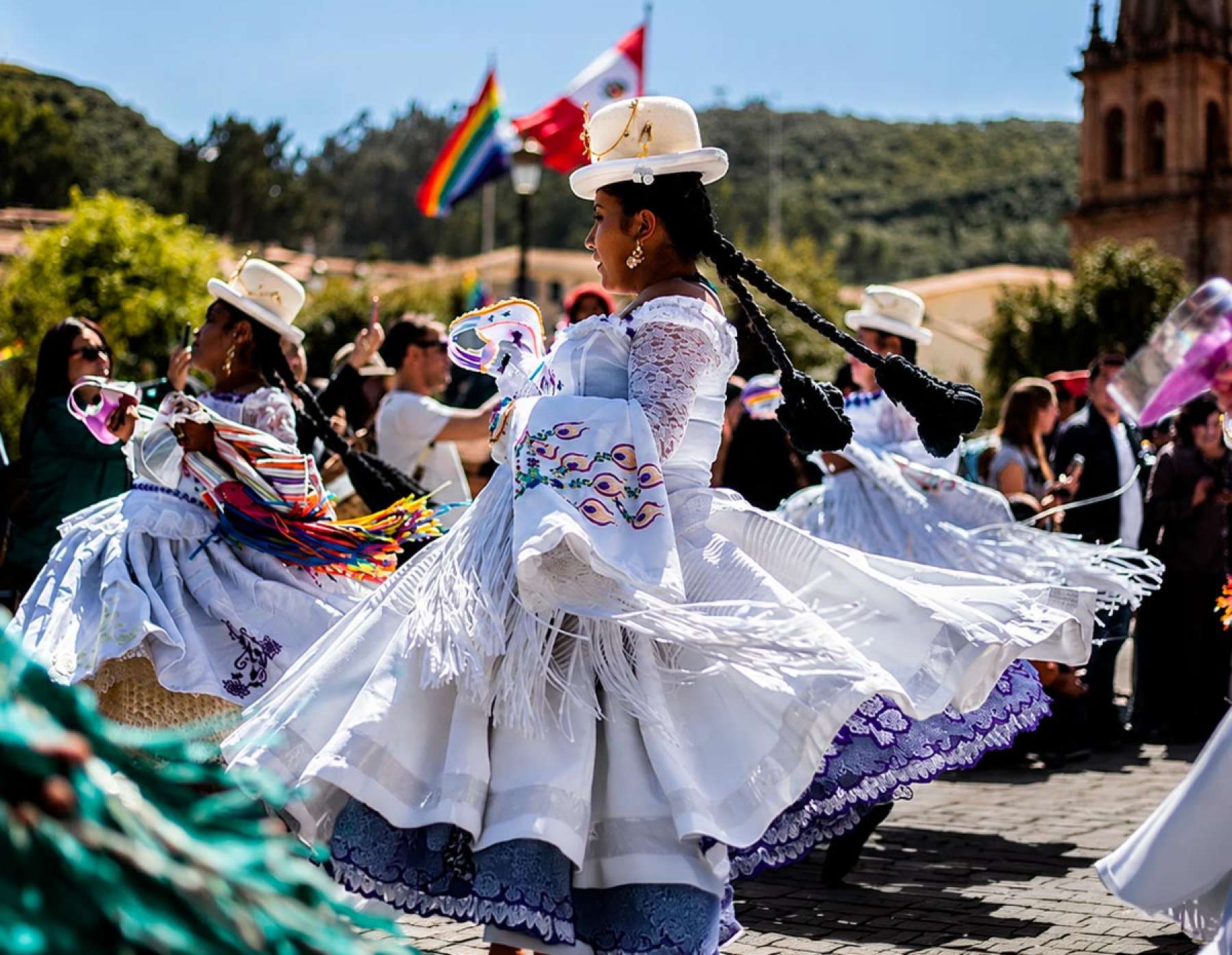
Peru is a country where thousands of years of history and an identity that keeps reinventing itself every day live together in the same territory. Its culture was not born from a single civilization, but from the overlapping of dozens of towns that left their mark on the pottery, architecture, textiles, and rituals that still last today. From Chavin to the Incas, and from the Colony to the Republic, each stage added layers to an identity that combines the Andean, the coastal and the Amazonian.
That diversity is noticed in every corner of the country. In the food, recognized among the most complete in the world, native ingredients like the potato and quinoa are mixed with techniques brought from Spain, Africa, China, Japan, and Italy.
In music and dances, the Andean huayno lives together with the coastal marinera and Afro-Peruvian rhythms. In festivals, celebrations like the Inti Raymi or the Fiesta de la Candelaria show that pre-Hispanic and colonial traditions did not disappear, but transformed into their own expressions.
This guide goes through the main pillars of Peruvian culture: its historical roots, the Inca legacy, the food, the music, the festivals, the textile art, and the diversity of languages and peoples that live together in the territory. The goal is to offer a complete view of what makes Peru a country with a unique cultural identity, both for those who plan to visit it and for those who want to better understand its history.
Long before the Inca empire existed, the coast and the northern highlands of Peru were the stage for civilizations that set the bases of the country's cultural identity: irrigation systems, monumental architecture, gold and silver work, and pottery that today is shown in the main museums of the world. To know them is to understand the starting point of Peruvian culture.
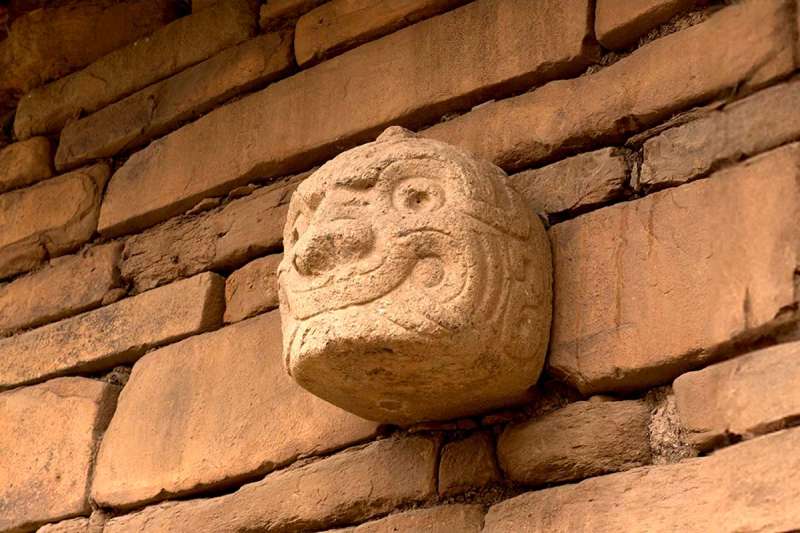
The Chavin culture developed between roughly 1200 BC and 200 BC, during the so-called Early Horizon, and is considered the "mother culture" of the central Andes for its influence on the civilizations that followed it. Its ceremonial center, Chavin de Huantar, was located in the current Ancash region, in the northern highlands, and spread religiously and culturally through a large part of the coast and northern highlands of the country.
The Chavin people worshipped feline gods and developed complex religious images, visible in pieces like the Lanzon Monolítico and the Tello Obelisk. Their pottery, of a compact style and sculptural decoration, can be seen today in museums in Lima and Trujillo, and the archaeological site of Chavin de Huantar was declared a World Heritage Site by UNESCO.
Around the year 100 AD, almost a millennium after the rise of Chavín, a highly advanced civilization bloomed in the Moche river valley: the Mochica. Their development lasted until near the year 700 AD on the northern coast of Peru, with administrative and religious centers like the Huaca del Sol and the Huaca de la Luna, near present-day Trujillo.
The Mochica designed irrigation systems that turned the coastal desert into productive farming lands, many of which are still in use. Their pottery, with realistic portraits and scenes of daily life, and their decorative motifs (some with similar images that have fed theories about distant contact or influences, although this point is still a matter of academic debate) reflect a complex and ranked society.
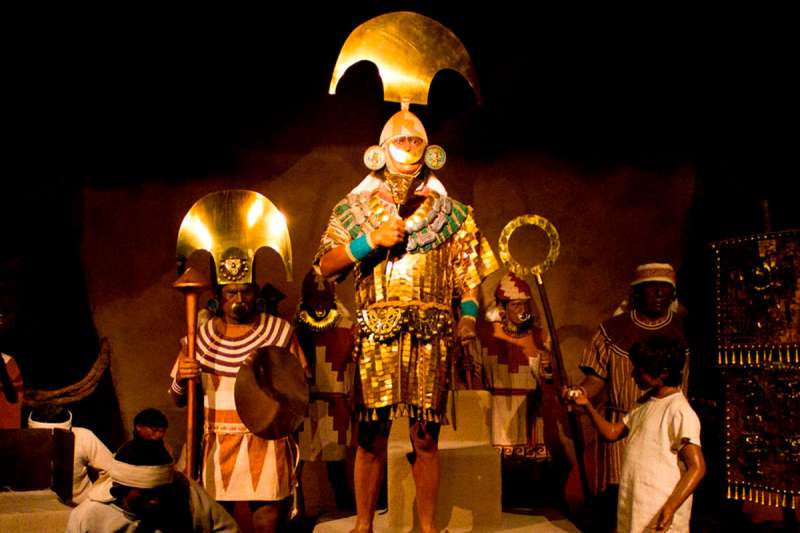
The most important finding to understand them came in 1987, when the Peruvian archaeologist Walter Alva discovered in Huaca Rajada, near Chiclayo, the untouched tomb of the Lord of Sipan, a Mochica ruler from the 3rd century. It was the first tomb of a pre-Inca leader found without signs of looting in Peru, and its more than 600 gold, silver, and copper pieces are shown today in the Royal Tombs of Sipan Museum, in Lambayeque.
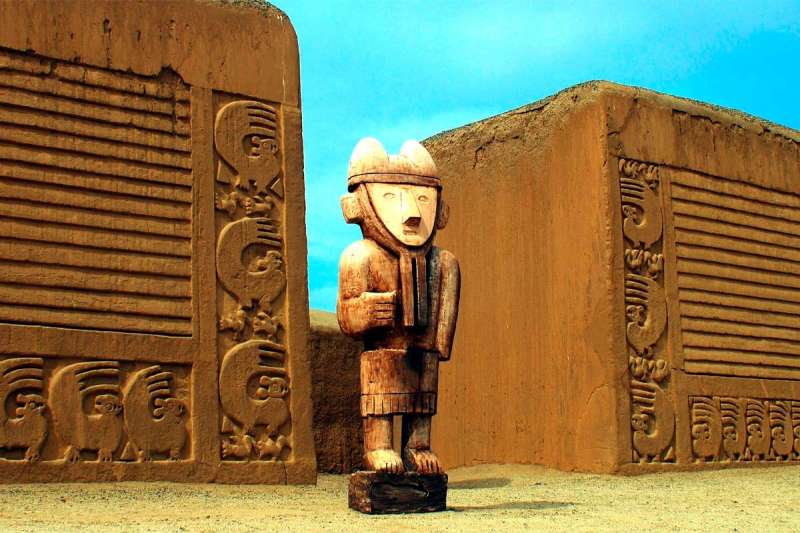
After the decline of the Mochica, and on the bases of their legacy, the Chimu kingdom arose around the year 900 AD, which became the largest and most powerful coastal state in pre-Hispanic Peru before the Incas. Its capital, Chan Chan, built near present-day Trujillo, was the largest mud-brick city in pre-Columbian America, with a population estimated in the tens of thousands of people.
The Chimu stood out in city planning, metalwork, and textiles, and expanded their rule along a large stretch of the northern Peruvian coast. Around 1470, the Inca empire conquered Chan Chan and absorbed the Chimú territory and craft knowledge, adding them to their own administrative system.
The conquest of the Chimu in 1470 was not an isolated event: it was part of the expansion process with which the Inca empire absorbed, in a few decades, most of the regional kingdoms and cultures of the Andean territory. Although the Inca center of power was located much further south, in the area of Cusco and Machu Picchu, its political and cultural influence ended up extending to the far north of present-day Peru.
This unification process is key to understanding Peruvian culture: each conquered civilization did not completely disappear, but provided techniques, beliefs and traditions to the great cultural mosaic that the Incas inherited and expanded, and which we explore deeply in the next section.
No civilization marked the identity of Peru as much as the Incas. Even though their peak lasted only two centuries, they managed to build the largest empire in pre-Columbian America and left a mark (architectural, linguistic and spiritual) that is still alive in the daily life of the country.
The Incas called their empire Tahuantinsuyo, a Quechua word that means "the four united regions". The territory was divided into four large suyos that met in Cusco:
At its greatest expansion, during the 15th century, the empire reached to cover about 2.5 million km², covering part of present-day Ecuador, Colombia, Bolivia, Chile and Argentina. This vast size was managed through a road network of thousands of kilometers, the Qhapaq Ñan, and a central government system that included the conquered towns without completely erasing their customs, but bringing them together under the authority of the Sapa Inca.
Cusco was founded, according to Inca tradition, by Manco Capac and Mama Ocllo next to Lake Titicaca, and it became the administrative, religious and military center of the Tahuantinsuyo. Its name, which in Quechua refers to the "navel of the world", shows the central place it held in the Andean worldview: from there the four suyos started, and towards there the taxes, the labor and the political power of the empire came together.
Under the rule of Pachacutec, in the 15th century, the city was reorganized and filled with monuments, temples, palaces and terrace systems that still today form a large part of the historic center of Cusco.
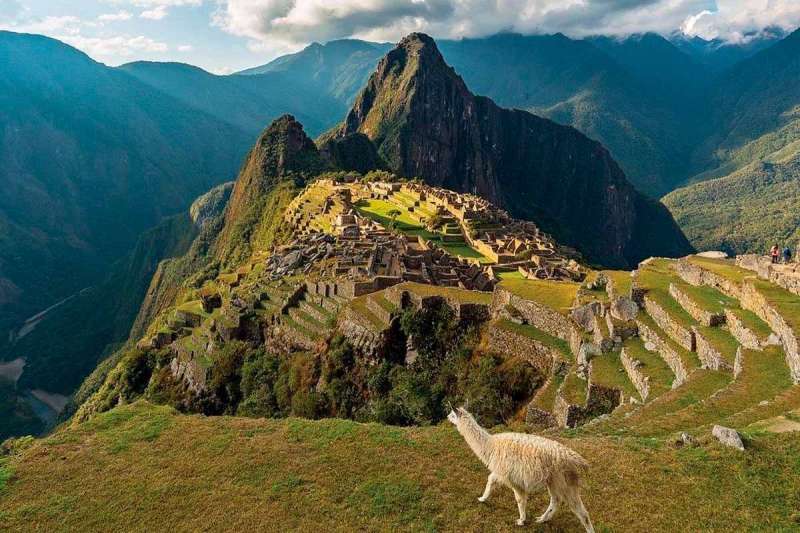
Built around 1450, during the rule of Pachacutec, Machu Picchu is the clearest example of Inca engineering: farming terraces that controlled erosion, water channels that still work, and a stone building technique so exact that the structures have lasted centuries of earthquakes without mortar. Its location, in the jungle edge between the Andes and the Amazon, also shows the Inca ability to adapt architecture to extreme geographies.
Quechua, the administrative language of the Tahuantinsuyo, did not disappear with the conquest: according to the last Census, more than 3.7 million Peruvians learned it as their mother tongue, about 14% of the country's population, gathered mostly in Apurimac, Huancavelica, Ayacucho and Cusco. Far from being a thing of the past, Quechua is spoken today in markets, homes and media, and it lives together with Spanish in a large part of the Peruvian mountains.
The end of the Inca empire was not a single event, but a process that lasted for four decades. In 1532, Francisco Pizarro arrived in Cajamarca in the middle of a civil war between the brothers Atahualpa and Huáscar for the throne. Pizarro captured Atahualpa and, despite the payment of a huge ransom in gold and silver, ordered his execution in 1533, which symbolically marked the fall of the Tahuantinsuyo.
The Inca resistance, however, continued for almost 40 more years from the refuge of Vilcabamba, until the capture and execution of Túpac Amaru I in 1572. That year formally closes the Inca period and gives way to the Viceroyalty of Peru, although a large part of the Inca heritage survived and mixed with colonial traditions to shape the current Peruvian culture.
Peruvian cuisine is, along with Machu Picchu, the most recognized cultural asset of the country: UNESCO declared ceviche an Intangible Cultural Heritage of Humanity, and Lima now gathers some of the best-rated restaurants in the world. But this cuisine was not born out of nowhere: it is the result of centuries of mixing between native products and techniques arriving from different continents.
The base of Peruvian food is in the products grown by pre-Hispanic civilizations: the potato, corn, chili pepper, and fresh fish from the coast were already part of the Andean diet thousands of years before the Spanish arrived. With the conquest, in the 16th century, European ingredients and techniques were added (wheat, beef, dairy, and citrus fruits) which blended with the local pantry.
The following centuries brought new layers of mixing: the African people brought during the Colony provided cooking techniques and dishes like anticucho and carapulcra; at the end of the 19th century Chinese migrants arrived, giving origin to the chifa fusion; and at the beginning of the 20th century, Japanese immigration set the base for nikkei food. This overlap of influences (Andean, Spanish, African, Chinese, Japanese, and Italian) is the reason why today Peruvian food is spoken of as one of the most complete cuisines in the world.
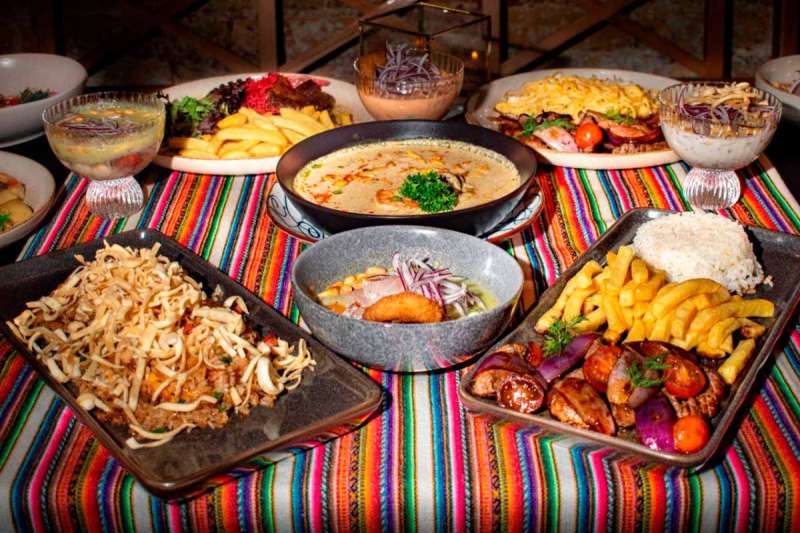
Ceviche, the iconic dish of the Peruvian coast, has pre-Hispanic roots: fishermen already soaked fresh fish with chili pepper and salt before the Spanish arrived. During the Tahuantinsuyo, Andean products like sweet potato and toasted corn were added, and its name is linked to the Quechua word "siwichi", which means tender fish. The addition of lemon to soak the fish arrived later, with the introduction of Spanish citrus fruits, shaping the recipe that is known worldwide today.
Along with ceviche, the Peruvian coast offers equally iconic dishes: tiradito, with nikkei influence, features fish cut into thin slices covered in chili-based sauces; seafood rice combines sea products with cooking techniques of Spanish origin; and causa limeña, made of mashed yellow potato, is one of the most representative cold dishes of Lima.
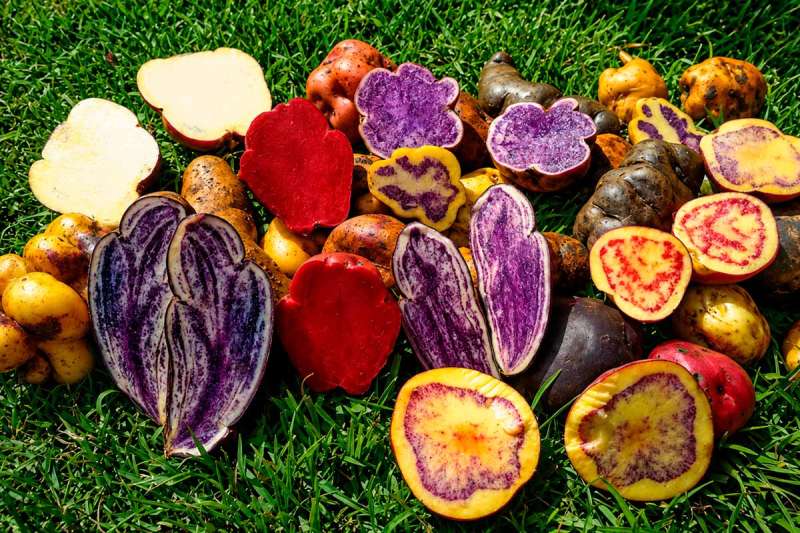
The potato, one of the most important elements of Peruvian cuisine, was grown about 8,000 years ago near Lake Titicaca, making Peru its center of origin. Today the country keeps more than 4,000 registered varieties, grouped into native, white, and yellow potatoes, each with specific cooking uses: from the yellow potato, ideal for causa and papa a la huancaína, to the huayro potato, the star of the pachamanca.
Next to the potato, quinoa is one of the great Andean gifts to gastronomy, a highly nutritious grain that the Incas considered sacred. Along with it, grains like kiwicha and cañihua complete the high Andean pantry, and today they are increasingly sought after for their nutritional value in international cuisine.
The cooking of the Andes keeps ancient cooking techniques, like the pachamanca, an underground cooking method with hot stones that dates back to pre-Hispanic times. Added to this are dishes like cuy chactado, prepared with this domestic rodent eaten in the Andean region for centuries, and Andean chicharrón, a mountain version of fried pork typical of local celebrations.
Pisco is a grape liquor with production records that date back to the 16th century, and since 1990 its designation of origin is legally protected in Peru, a recognition that the European Union has accepted. It was declared Cultural Heritage of the Nation, and every fourth Sunday of July, National Pisco Day is celebrated.
Peruvian music is as diverse as its geography: the Andes, the coast, and the jungle have their own rhythms, instruments, and dances, often the result of the same mixing of cultures that shaped the country's food. Exploring them is another way to understand the Peruvian cultural identity.
Huayno is the most widespread musical genre in the Peruvian mountains, with roots that go back to pre-Hispanic ritual dances and that later added string instruments that arrived with the Colony, like the guitar and the charango. It is known for a strong two-beat rhythm and lyrics that are usually sung in Quechua or Andean Spanish, and it has its own regional types in Ayacucho, Cusco, Puno, Junín, and Ancash, among other high Andean areas.
The marinera is the most representative dance of Peru and was the first artistic expression to be declared Cultural Heritage of the Nation, in 1986. It is born from the mixing of colonial ballroom dances, native roots, and Afro-Peruvian rhythms, and it shows a courtship between a couple: the man wins her over with a handkerchief and a hat, while the woman answers with elegance and charm.
It has different regional types (from Lima, from the North, from Puno, from the mountains), being the northern marinera the most known internationally for its energy and its typical barefoot dancing. Trujillo is its center: every January the National Marinera Contest is held there, which the city of La Libertad, declared "National Capital of the Marinera" since 1986, organizes since 1960. Since 2012, October 7 is celebrated as the National Day of the Marinera.
Festejo is one of the most lively musical and dance genres of Afro-Peruvian music, born in the communities of the central and southern coast during the Colony. It is known for a happy rhythm with a strong beat, played mainly with a cajon and a cajita, and for a dance with fast hip movements that celebrates community life. It is part of a larger Afro-Peruvian collection that includes genres like the lando and the son de los diablos, all of them part of the Afro-Peruvian cultural rebirth pushed in the 20th century by artists like Nicomedes and Victoria Santa Cruz.
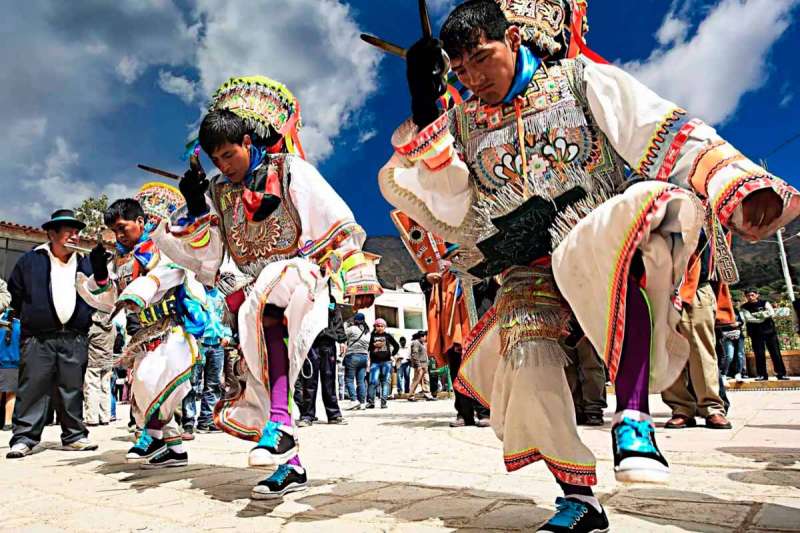
No part of Peruvian culture is lived with such group energy as its festivals: Inca rituals that survived the conquest, Catholic beliefs brought by the Spanish, and a mixed identity that gave new meaning to both traditions in its own way. Going through the country's festival calendar is a good option to know its history.
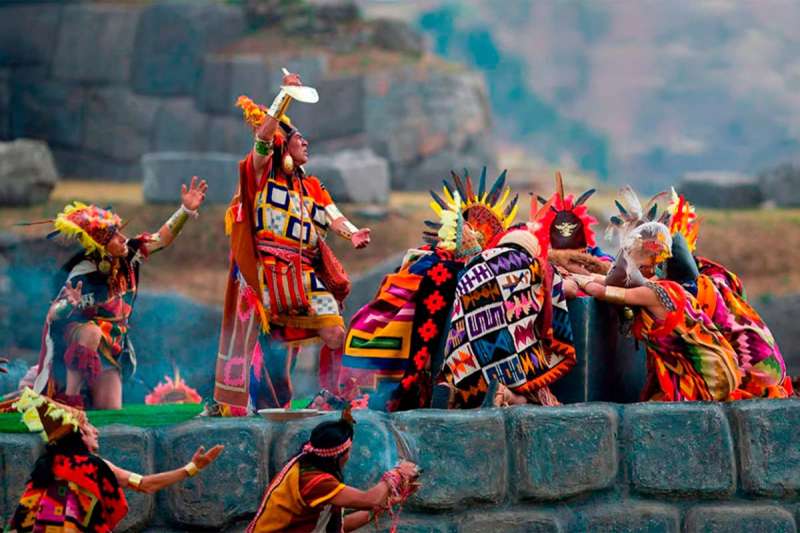
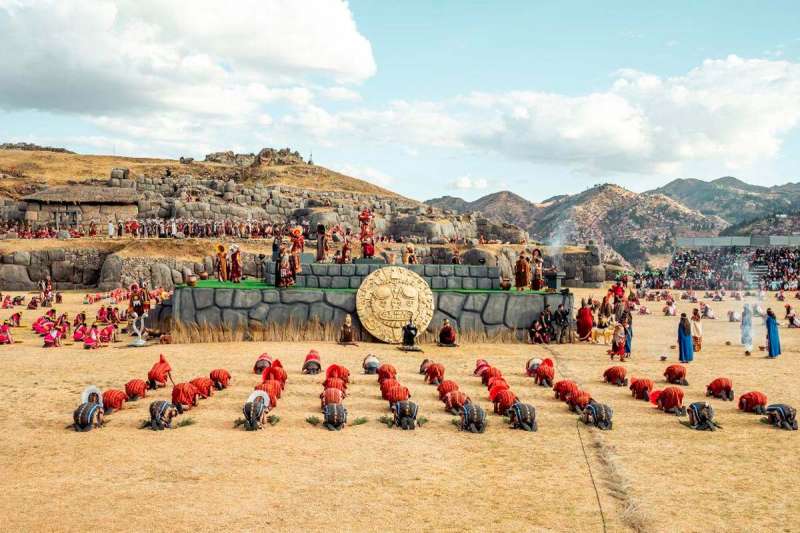
The Inti Raymi, or "Festival of the Sun", was the most important ceremony of the religious calendar of the Tahuantinsuyo: a tribute to the sun god Inti that, according to tradition, was started in the 15th century by the Inca Pachacutec as part of a religious reform and that gathered representatives from the four regions of the empire. The celebration was banned during colonial times and disappeared from public life in Cusco for almost four centuries, until in 1944 the Cusco intellectual Faustino Espinoza Navarro promoted its first modern reconstruction, based on the records of the Inca Garcilaso de la Vega and with a script entirely in Quechua.
Today, every June 24 (a day that matches the winter solstice in the southern hemisphere), Cusco brings the ceremony back to life in three following stages: the Qorikancha, ancient temple of the Sun, where the Inca calls upon the star; the Main Square, ancient Haukaypata, where he receives the authorities; and the Sacsayhuaman fortress, where the high point of the ritual takes place with dances and offerings. The current performance gathers more than 600 artists, dancers, and musicians who represent the ancient towns of the empire, and the event was declared Cultural Heritage of the Nation and Official Act of National Identity in 2001.
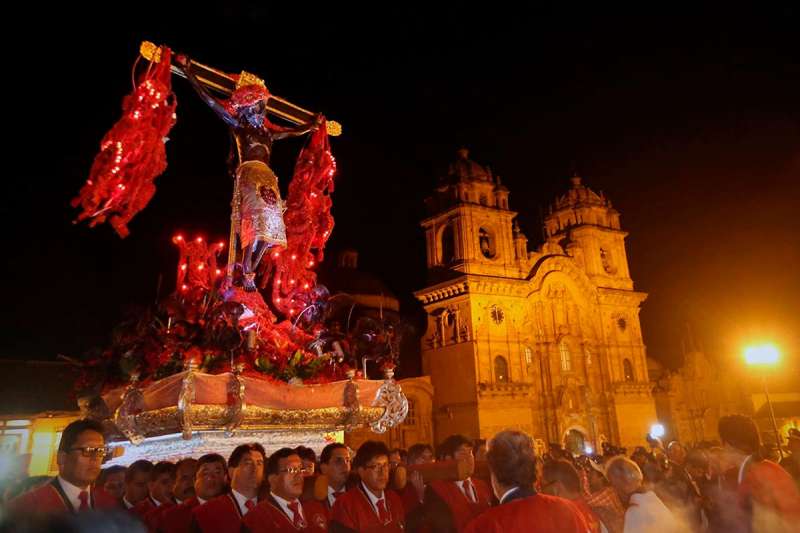
The Peruvian Holy Week has two main centers. In Cusco, the main day is Holy Monday, when the Lord of the Earthquakes, also called Taytacha of the Earthquakes, goes out in a procession. His devotion was born because of a 7.6 magnitude earthquake that shook the city on March 31, 1650; it is said that the faithful took this image (until then not much worshipped) out in a procession and the earthquake stopped, which earned him his new name and, over time, the title of Sworn Patron of Cusco. The procession, started that same year, began to be held every Holy Monday starting in 1741, marking since then the start of the Cusco Holy Week.
In Ayacucho, Holy Week has a completely different scale: it is the most important religious and cultural festival in the city, and one of the most crowded expressions of faith and mixed beliefs in Latin America, beaten only by the one in Seville. Among its most unique moments are Glory Saturday, with the burning of dry branches and the little fire bulls, and Resurrection Sunday, when the Risen Christ comes out on a platform of more than ten meters considered the largest in the country.
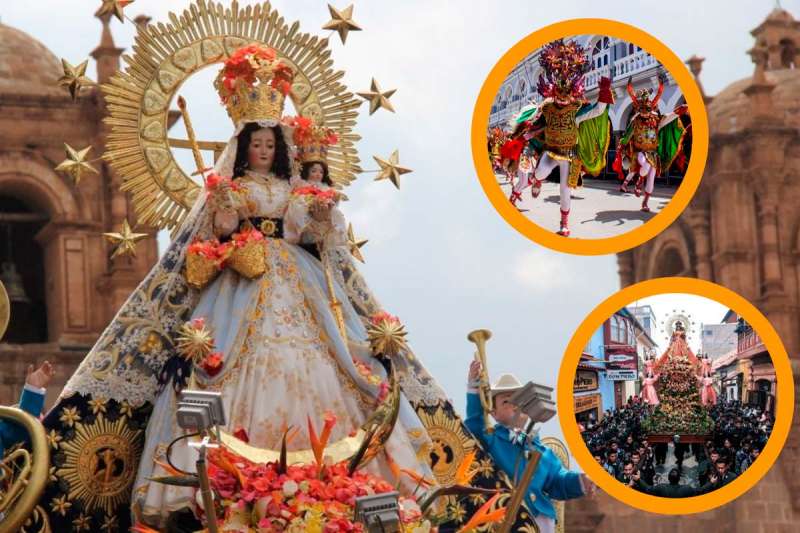
Based in the high plain city of Puno, the Festival of the Virgin of the Candelaria is the largest religious, musical, and dancing celebration of its kind in Peru. It combines Quechua, Aymara, and mixed traditions in honor of the patron saint of Puno, and gathers every February tens of thousands of dancers and musicians: about 170 groups from all over the region, which together gather around 40,000 participants, competing in dance contests that combine religious devotion with a deeply rooted cultural identity.
Its importance was recognized internationally when Unesco declared it Intangible Cultural Heritage of Humanity on November 27, 2014, a process that had started with its declaration as national heritage. For the application to Unesco, three elements were especially important: popular faith, the handmade work behind costumes, boots, and masks, and dance as a way of an expression with pre-Hispanic roots.
Outside of these three big events, the Peruvian calendar is sprinkled with festivals just as revealing of its mixed identity:
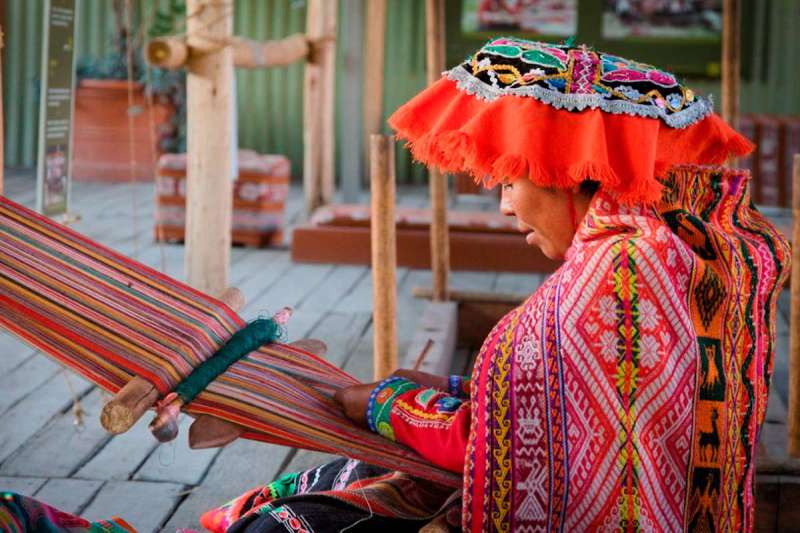
Beyond music and food, Peruvian creativity is expressed with the same strength in textiles, pottery and popular art: three traditions that go across thousands of years and that last in family workshops in the mountains and the coast.
The Andean textile tradition is, along with pottery, one of the oldest art expressions in Peru: there is proof of handmade weaves from the second or third millennium before Christ, centuries before cotton and camelid wool spread together across the coast and the mountains.
Each design answers to a clear symbol code rather than just being for decoration. An example is the tiklla, a ceremonial weave exclusive for ritual leaders and rulers that mixes in four spaces of different colors (red, green, orange and purple or black) figures linked to the apus, the pachamama and natural events, symbolically representing the four regions of the Tahuantinsuyo.
The dyes, also, are still taken from natural sources: the cochineal for carmine red, the indigo for blue and native flowers like the q'olle for yellow. Communities like Chinchero, Pitumarca and the Taquile island, in Lake Titicaca, keep this trade alive, and in Taquile the weave itself gets to define the social organization of the community.
Pre-Hispanic Peruvian pottery reached one of its highest points with the Nazca culture (200 B.C.–600 A.D.), indirect heir to the image tradition started by Chavín and perfected in story-telling by the Moche. The distinct thing about Nazca pottery is its many colors: the potters used between eight and sixteen colors per piece (white, black, red, orange, violet, gray, among others), put on before baking and always outlined with thin black lines.
This pottery talks with the previous heritage of Chavín, of a more sculpture-like and compact style, and with the one from Moche, famous for its realistic portraits of daily life. Together, these three traditions form the base on which a good part of the pre-Inca pottery that today is shown in museums like the Larco or the Rafael Larco Herrera in Lima is understood.
The Ayacucho retablo is maybe the clearest example of how a colonial tradition changed into an expression of regional identity. Its origin is in the "San Marcos boxes" or "saint-maker chapels", hinged wooden boxes that the Spanish priests carried on their teaching trips, with small figures of Catholic saints inside.
The Huamanga craftsman Joaquín López Antay (1897-1981), trained since he was a boy in his grandmother's workshop, was the one who changed this religious piece into the retablo as it is known today. By suggestion of the native painter Alicia Bustamante, he added from 1940 everyday scenes (festivals, farm work, dances) next to the figures of saints, as well as colorful and flower designs. His work was recognized in 1975 with the National Culture Award, being the first time in the country's history that a craftsman was awarded in that category, which made the Ayacucho retablo strong as a symbol of Peruvian popular art.
Peru does not have a single culture, but many living together in the same territory. That diversity is shown more clearly in its languages and in the peoples who speak them: Quechua and Aymara in the Andes, Afro-descendant communities on the coast and dozens of native peoples in the Amazon.
Quechua is, after Spanish, the language with the most native speakers in Peru. According to the National Census, the country has 3,799,780 speakers of Quechua as a first language, a share of 13.6% of the total population, gathered mostly in Apurímac, Ayacucho, Huancavelica and Cusco, where in some regions up to half of the population learned it as a native language.
Aymara, on its side, is the second most spoken native language in the country, gathered mostly in the high plateau regions of Puno, Tacna, Moquegua and Arequipa, where in some provinces up to one in four inhabitants learned it in childhood. Both languages, together with the Amazonian languages, have a constitutional recognition as official languages where they are the most spoken.
The Afro-descendant presence in Peru goes back to the first years of the conquest, when enslaved people from West Africa started to arrive to work in the coastal farms and domestic service of the viceroyalty. At some points in the 16th century, more than 60% of the population of Lima was of African origin, a fact that contrasts with how little the official Peruvian history has recognized their contribution.
That legacy is visible today in music (festejo, landó, the Peruvian cajon), in food (anticucho, carapulcra) and in historical figures like San Martín de Porres. The 20th century brought a cultural revaluation movement led by artists like Nicomedes and Victoria Santa Cruz, which rescued Afro-Peruvian rhythms and traditions from being forgotten and which is celebrated today every June 4, Day of Afro-Peruvian Culture.
The Peruvian Amazon gathers the greatest ethnic diversity in the country: according to the Database of Indigenous or Native Peoples of the Ministry of Culture, out of the 55 recognized indigenous or native peoples in Peru, 51 belong to the Amazon and only 4 to the Andean zone. These communities are grouped into several language families (Arawak, Jivaro, Pano, Tupi-Guarani, among others), being the Arawak the most widespread and with the largest population, with peoples like the Asháninka, Shipibo-Conibo, Aguaruna (Awajún) and Cocama-Cocamilla among the most numerous.
Beyond the language diversity, these communities share traits of a common worldview: a deep relationship with the forest and the river as living beings, the ritual and medical use of plants like ayahuasca, and a social organization where the knowledge of the natural environment (plants, animals, seasonal cycles) is passed down verbally between generations. It is a way of understanding the world that contrasts with the Andean worldview of worshiping the apus, but that shares with it the idea of a sacred and living nature.

 +51 84 226 547
 +51 912 891 560
 Av Tupac Amaru PP-10B, Santiago, Cusco, Peru
  info@salkantaytrekmachu.com
 www.salkantaytrekmachu.com