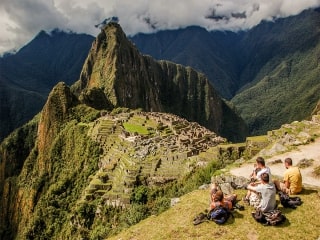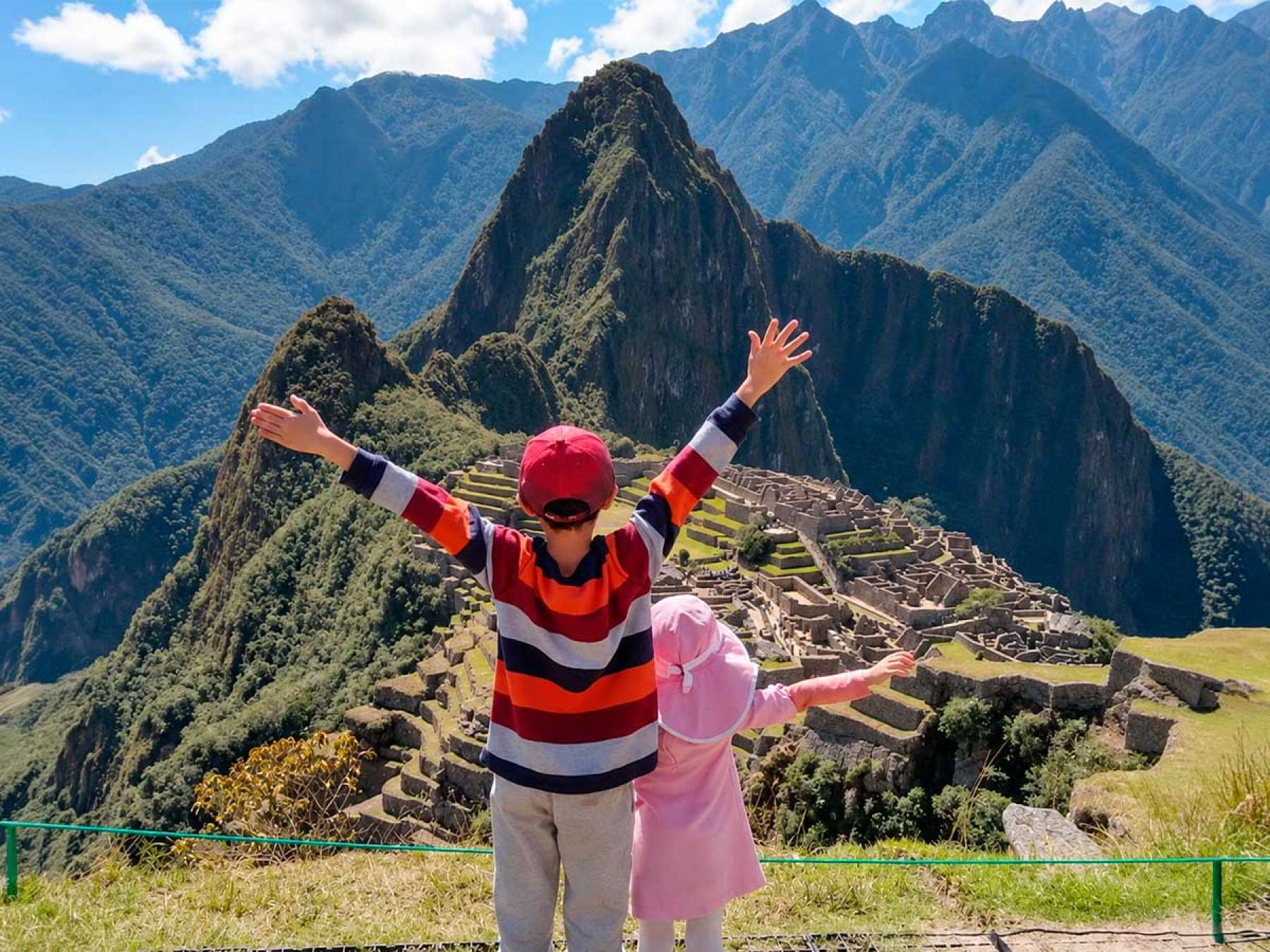
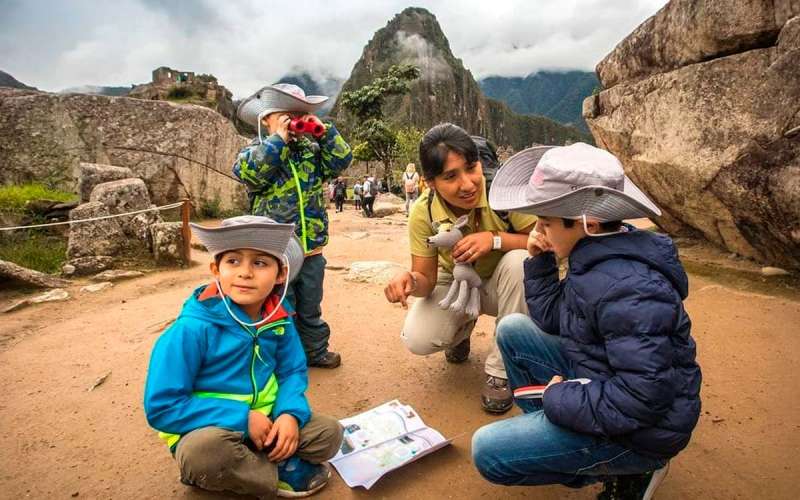
Can you visit Machu Picchu with children? Yes, and it is one of the most complete excursions a family can do on their visit to Peru. There is no minimum age to enter the citadel, and every year families with children of different ages visit it. For children, the trip begins before arriving. Many take the train ride, walk among stone terraces and enclosures, and see llamas at the site, and that is usually easier to remember than a visit to a museum. For adults, it is an opportunity to share a place that their children may still remember when they grow up.
Even so, it is convenient to plan in advance. The age of the children, acclimatization to altitude (Cusco is at about 3,400 m above sea level, while Machu Picchu is at about 2,400 m), the chosen circuit within the citadel, and the organization of transportation directly influence how the day will turn out.
In this article, we review those factors, what to consider according to age, how to get there with children, which circuit is convenient, and what to bring to make the visit comfortable for everyone.
Yes, in most cases it is recommended, as long as the tour adapts to the age and pace of each child. Many families make the visit to Machu Picchu with children without problems, although it requires more planning than an adults-only trip.
The Machu Picchu ticket has no age restriction, but there is no ideal age that works for all families either. What matters most is the physical stamina of the child, whether they walk on their own, and how much they tolerate long journeys (train, bus, lines, and several hours of touring). As a guide:
It is best to postpone the visit if the child is sick or feeling unwell from the altitude, if they have a health condition that makes walking for several hours or being at high altitude difficult (in that case, it is best to consult with the pediatrician beforehand), or if the itinerary is so tight that it leaves no time to rest.
Children are usually interested in the Inca constructions, especially when a guide explains them with simple stories about who lived there and what each space served for. The llamas grazing on the terraces, the stone paths, and the mountain views also catch their attention. To keep them engaged, the tour can be turned into a simple activity: searching for llamas, counting steps, or finding the most important temples.
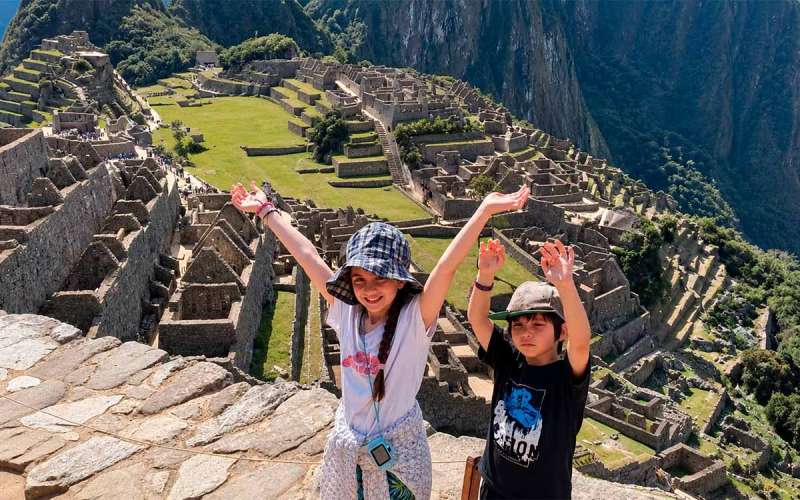
The best time to visit Machu Picchu with children will depend on the travel experience, that is, whether having good weather or avoiding crowds. No season is bad, but each demands different preparation.
It is worth noting that April and May, when the rains end, and September and October, before they return, usually offer a middle ground to visit the citadel, as there is less rain than in the middle of a wet winter and less crowding than in June, July, and August, which are the months of highest influx.
If the children are young, it is best to choose a morning slot. The temperature is more pleasant, children have more energy, and the hours of greatest heat and fatigue are avoided. Early in the morning there may also be fog, which usually clears as the hours pass.
To compare with other destinations in the country and plan the rest of the trip, you can check our guide on the best time to travel to Peru.
Machu Picchu is at a lower altitude than Cusco, but many families arrive in Cusco first, and that is where the effects of altitude are usually felt the most. With children, it is best to know the altitude differences of the tour and keep them in mind when building the itinerary.
During a trip to Machu Picchu, altitude varies depending on the places visited. Cusco is located at a higher altitude, while the Sacred Valley and Aguas Calientes are in lower zones. Knowing these differences is important when traveling with children, as it allows for better acclimatization planning and reduces the risk of altitude sickness.
These are the approximate altitudes of the main destinations along the route:
For families traveling with children, spending the first nights in the Sacred Valley can be a good alternative, as its lower altitude allows for a more gradual adaptation than staying directly in Cusco. It is important to remember that each child responds differently, so it is advisable to do quiet activities during the first few days and pay attention to any symptoms.
The most frequent symptoms are headache, nausea, fatigue, and loss of appetite. In young children, who cannot always explain how they feel, the signs can be less clear: irritability, frequent crying, excessive sleepiness, or refusal of food and games they normally like. If you notice changes of this type, it is wise to take them into account and slow down the pace.
If symptoms are intense, persist, or worsen (for example, repeated vomiting, difficulty breathing at rest, extreme drowsiness, or confusion), it is recommended to seek medical attention. It is also a good idea to speak with a doctor if you have any questions, without waiting for symptoms to become severe.
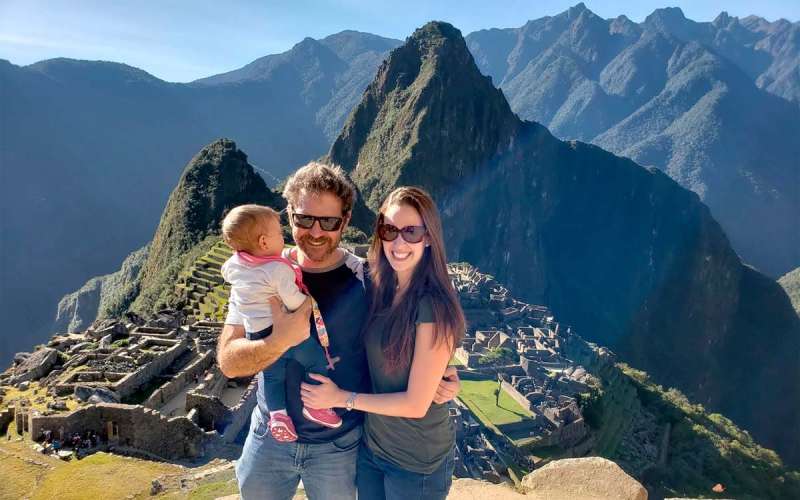
To reach Machu Picchu, you need to know that there is no direct road. Access is by train to Aguas Calientes and, from there, by bus to the entrance. With children, it is advisable to plan each segment with plenty of margin, because waiting and travel times count just as much as the tour of the citadel itself.
The most widely used departure station for families is Ollantaytambo, in the Sacred Valley. From there, the trip to Aguas Calientes takes about 1 hour and 20 minutes, a short time for young children. There are also trains from Cusco (Poroy station), but the journey is considerably longer: the return from Aguas Calientes to Poroy is advertised at about 3 hours and 50 minutes. If children are young, Ollantaytambo is usually the most comfortable option.
Some tips for traveling with children and babies:
From Aguas Calientes, the only authorized transport to the citadel entrance is the bus operated by the Consettur company. The journey takes approximately 25 to 30 minutes along a winding road. Bus tickets can be purchased in advance online or at the Consettur office in the town.
Going up by bus is the most practical option with young children. The alternative of walking up can take about 2 hours on a continuous slope, which means children would arrive tired before even starting the tour of the citadel.
When traveling with children, this is usually convenient. Sleeping in Aguas Calientes allows entering Machu Picchu early, when the temperature is more pleasant, without depending on the first train. It also gives margin to rest after the trip and allows dividing the effort over two days.
The day trip from Cusco is possible, but it implies a very long day. Some tours pick up passengers at the hotel between 3 and 4 in the morning to catch the train, and the return is equally late. For young children, this day can end up being exhausting. If budget or time only allows for a full day trip, it is best to choose a train departing from Ollantaytambo and book an entry time that leaves breaks to rest.
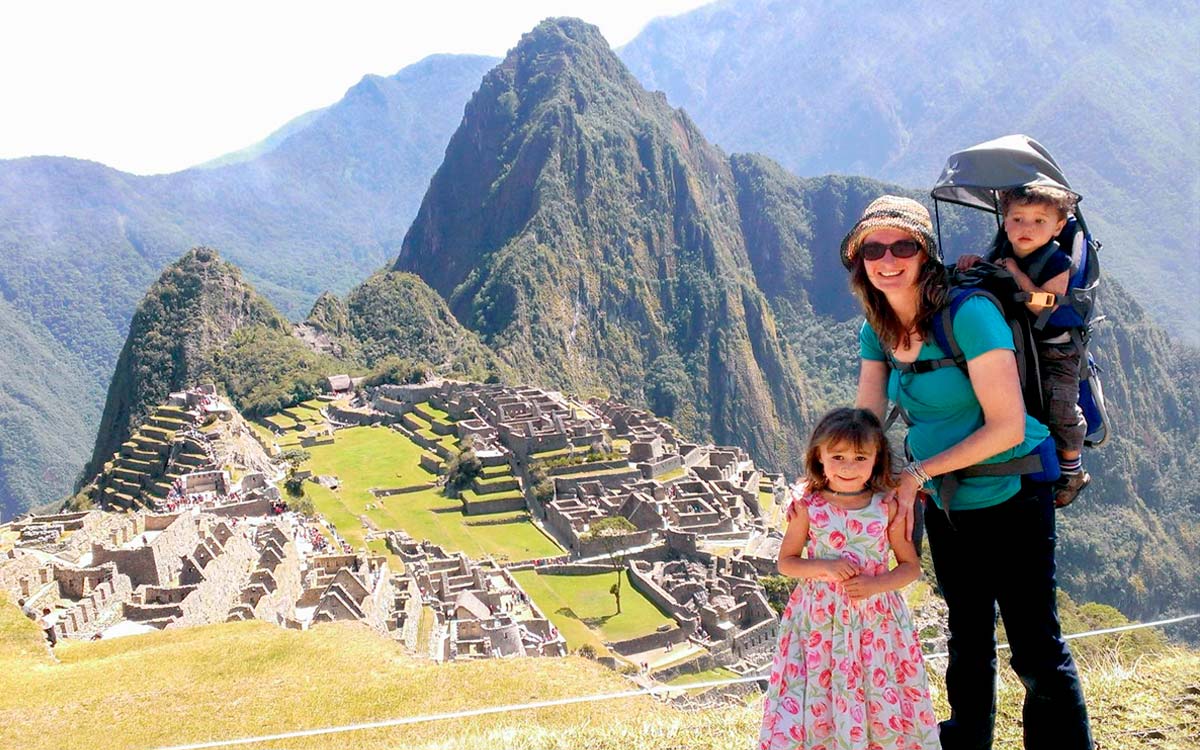
Buying tickets in time and carrying the correct documents avoids problems at the gate, especially when the whole family travels. This is what you should keep in mind when traveling to Machu Picchu with children.
The rate depends on age and the nationality or residency of the visitor. Children under 3 years old enter for free, and those from 3 to 17 years old pay a reduced rate.
In the case of Peruvians, residents and citizens of the Andean Community, the Ministry of Culture set promotional rates for this year. In Circuit 2 (classic), students and minors from 3 to 17 years old pay S/ 32, and on the mountain routes, S/ 80.
Foreign visitors pay a higher, separate rate. In addition, starting May 1, 2026, a SERNANP conservation fee is added to each ticket. According to reports, the increase is 5 soles for foreign minors and 11 soles for foreign adults.
Some practical recommendations:
All family members, including children, must present their document upon entering:
To see the rest of the visitor rules, such as allowed items or the circuit tour, consult our rules for visiting Machu Picchu guide.
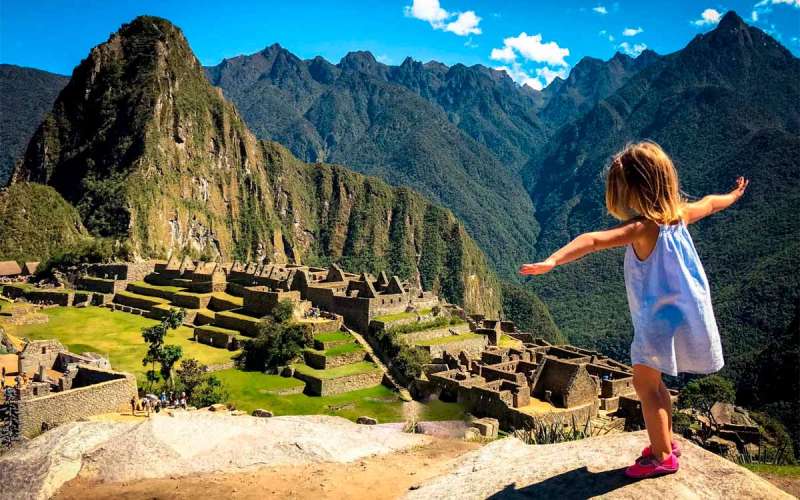
Machu Picchu is toured via circuits and fixed-direction routes, and the ticket defines which one you will traverse, so the choice should be made before purchasing. With children, the important thing is that the tour adapts to their age and stamina.
| Route | Characteristics | Family consideration |
|---|---|---|
| 1-B: Upper Terrace | Panoramic views | Requires access to viewpoints and climbs. It is a short walk. |
| 2-A and 2-B: Classic Machu Picchu | Sectors of the Inca city | For children capable of walking and climbing stairs. Offers the classic photo and the visit to the lower section of the ruins. |
| 3-B: Designed Royalty | Lower sector of the complex | You can visit it with young children, but it has uneven ground. Does not include the classic photo. |
With children, Circuit 2 is usually the most complete option, because it combines high views with the visit to the constructions. Circuit 3 in its route 3-B is an alternative with fewer crowds, but it has elevation changes and does not offer the classic panoramic view.
Mountain routes and more demanding hikes are not suitable for young children:
It is convenient to distinguish two things: the maximum time authorized by the ticket and the time a family can comfortably maintain. On routes 1-B, 2-B, and 3-B, the maximum authorized stay in the citadel is 2 hours and 30 minutes, and a typical tour of Circuit 2 ranges between 2 and 2 and a half hours.
The comfortable time depends on the age and pace of the children. The youngest may get tired before finishing the tour, while older ones usually keep the pace throughout the entire circuit. Since tours have a fixed direction and stay is limited, it is not wise to count on improvising shortcuts or extending the visit. The best thing is to choose a route according to the children, enter early, and schedule a calm pace within the allowed time.
A visit to Machu Picchu with children goes better when it is prepared with some anticipation and adapts to the pace of the little ones. These ideas help make the experience more bearable for the whole family:
With children, the itinerary matters just as much as the circuit inside the citadel. The two we propose start in the Sacred Valley, which is lower than Cusco, so the family acclimates more smoothly. In addition, sleeping in Aguas Calientes the night before avoids early wake-ups and long transfers on the very day of the visit.
| Day | 3 day option | 5 day option |
|---|---|---|
| 1 | Arrival in Cusco and direct transfer to the Sacred Valley | Arrival and rest in the Sacred Valley |
| 2 | Train to Aguas Calientes and restful afternoon | Peaceful tour through the Sacred Valley |
| 3 | Visit to Machu Picchu and return to Cusco | Train to Aguas Calientes |
| 4 | — | Visit to Machu Picchu |
| 5 | — | Return to Cusco |
It is the shortest and works best with children over 8 years old who have already traveled or have no problems with altitude. It has little margin: if a child wakes up feeling unwell, there is no backup day to adjust the plan. The day of the visit is also long, because it includes Machu Picchu, the return train, and the transfer to Cusco. It is advisable to book the earliest possible entry slot and ensure the children sleep well the night before.
It is the one we recommend for families with young children or with doubts about altitude. The second day is dedicated to exploring the Sacred Valley without rush, with one or two stops per day, such as an artisan market, a weaving village, or the ruins of Ollantaytambo. This serves both as acclimatization and as an introduction to Inca culture before reaching Machu Picchu. Upon returning to Cusco on the last day, the family can rest or spend the afternoon at the main square and the San Blas neighborhood.

 +51 84 226 547
 +51 912 891 560
 Av Tupac Amaru PP-10B, Santiago, Cusco, Peru
  info@salkantaytrekmachu.com
 www.salkantaytrekmachu.com