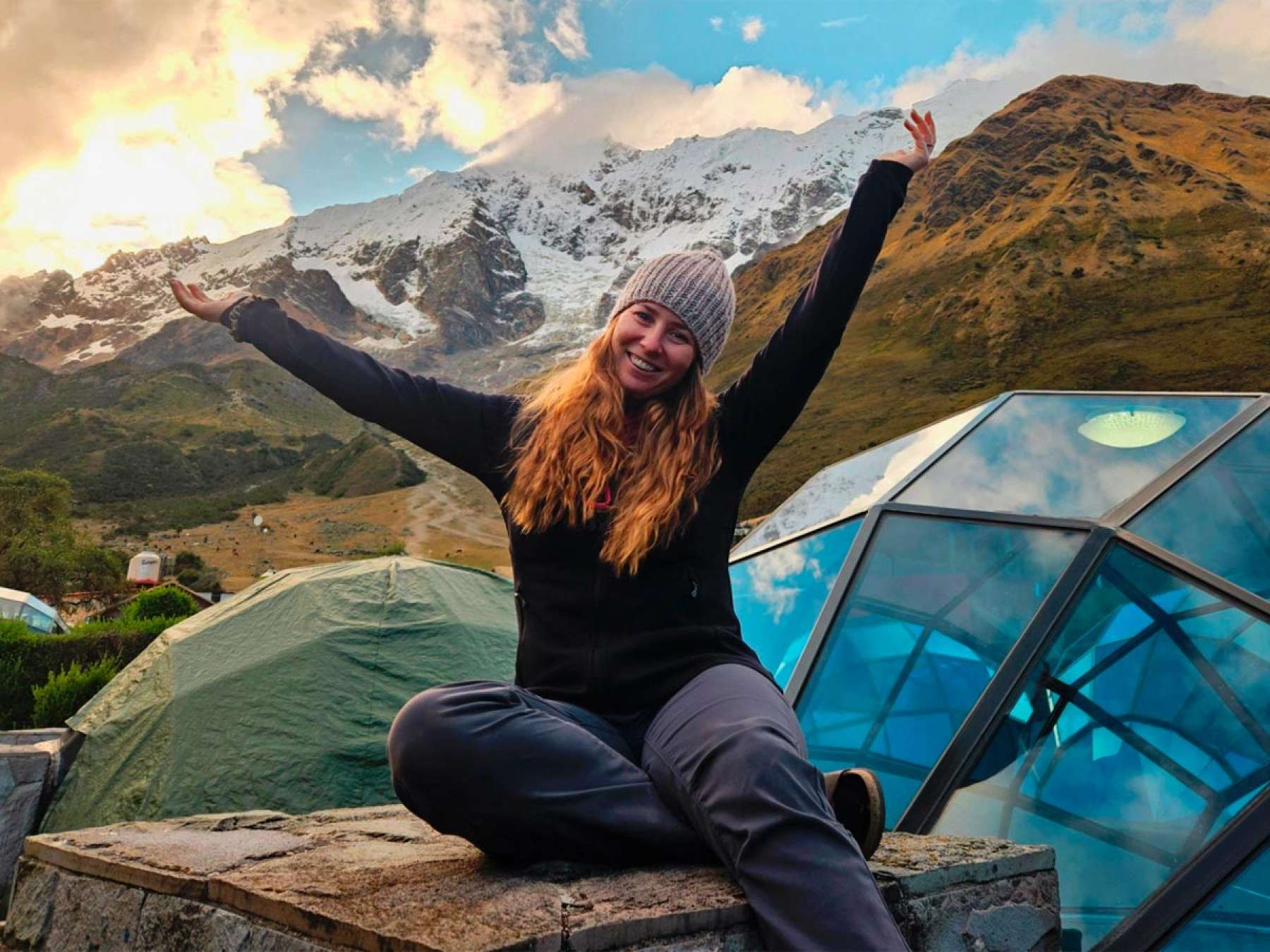
The Machu Picchu Sky Domes tour covers the Salkantay Trek in 5 days and combines hiking with nights in domes, instead of traditional camping. The route crosses the Salkantay mountain, one of the highest peaks in the Cusco region, and descends from the high mountain down to the high jungle. Along the way you see glaciers, lagoons, agricultural valleys, and cloud forests, with climate and vegetation changes almost every day.
At the end of each day, the group rests in domes with a bed and an open view of the landscape. This allows you to walk with less weight and sleep better than in a tent, something you notice especially during cold high-altitude nights. The final stretch leads to Machu Picchu, one of the seven wonders of the modern world; where travelers will have the opportunity to visit the Inca citadel. Along the way they will learn about its history, architecture, and the role it played within the empire; all of this accompanied by a professional guide.
It is an itinerary designed for those who want to do the Salkantay with better rest on the route and everything included: equipment, accommodation (in domes), and entrance tickets to Machu Picchu.
Day 1: Cusco – Challacancha – Soraypampa
Day 2: Soraypampa – Salkantay Pass – Chaullay
Day 3: Chaullay – La Playa (coffee plantation)
Day 4: La Playa – Llactapata – Hydroelectric – Aguas Calientes
Day 5: Aguas Calientes – Machu Picchu – Cusco

The day starts with hotel pickup in Cusco, with a specialized mountain guide who accompanies the group throughout the entire route. The journey to Soraypampa takes several hours and follows the road toward Limatambo and Mollepata. In Mollepata, a stop is made to have a good breakfast.
From Mollepata, the trail continues along a dirt road that climbs toward Challacancha and then toward Soraypampa, where the dome camp is located. During this stretch the landscape changes from an agricultural valley to puna, and the Salkantay mountain starts to appear right in front. Upon arrival, the team shows you the dome, which has a bed, private bathroom, and a hot water shower. From the dome you can see the Salkantay and Humantay snow-capped peaks.
Depending on the arrival time, the group sets out on a guided hike toward the Humantay lagoon, a walk of approximately 1 h 30 min; it is worth noting that the pace is slow, because the altitude requires stopping to breathe. Upon reaching the lagoon you see its turquoise color, which is due to minerals coming down from the Humantay glacier. Likewise, the guide explains the origin of the place and the meaning it has for the local communities, who consider the mountains as Apus, protective spirits.
At the shore of the lagoon, an Andean ceremony of gratitude to Pachamama and the Apus is performed. It is a traditional offering where the guide explains each element and each traveler can participate. Then the group has some free time to look at the lagoon, take pictures, and rest before walking down to the camp.
Back in Soraypampa, the chef prepares lunch, featuring a typical Peruvian dish, and explains what it is made of and how it is prepared. After lunch there is free time to rest in the dome. At nightfall a campfire is lit, where dinner is served and conversations take place about the next day's route. Nights in Soraypampa are cold, so going to bed early is recommended. Day 2 is the longest stage of the trek, with the climb to the Salkantay pass, and it is best to be well-rested.
Trip Facts
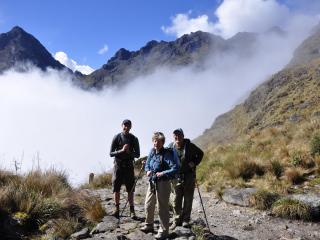
Day 2 is the most demanding of the route and starts early. At 5:30 a.m. hot coca tea is served at the camp, followed by breakfast. With the group ready, the climb toward the Salkantay pass begins, the highest point of the hike, at 4,650 m (15,200 ft). The climb is steady, in zigzag sections known as "the route of the seven serpents"; likewise, the pace of the hike is slow and the guide makes frequent stops for the group to breathe and adapt to the altitude.
As you go up, the landscape changes from grasslands to rocky and snowy terrain. The path passes between two mountains, the Salkantay peak and Tucarhuay, and from there the scale of the mountain range can be appreciated. With some luck, you can see snow avalanches in the distance and Andean condors flying over the area. Likewise, the guide explains the meaning of Salkantay as an Apu for the communities of the region.
At the top of the pass, a stop is made to rest, take photos, and celebrate the achievement of reaching the highest point of the trek, but the time at the top is short; since the wind and cold are strong and it is best to bundle up as soon as you arrive at the spot. Then the descent begins, which is long and changes the landscape sharply: from rock and snow it shifts to ravines with vegetation and, little by little, to the cloud forest.
Lunch is served in Huayracmachay, already in the lower part of the descent. Afterward, the journey continues down toward the high jungle fringe, which is at a lower altitude and where the weather becomes warmer and more humid, and orchids, ferns, and other species typical of the cloud forest appear. The day ends upon reaching Chaullay, where dinner is served and the group rests to continue the next day.
Route Details
Day 3 starts with breakfast at 6:30 a.m. at the Chaullay camp. After the demanding Salkantay pass, today's hike is more relaxed and goes in a gentle descent, in a high jungle fringe zone, where the vegetation is denser and the weather warmer and more humid. The pace allows observing the flora and fauna of the surroundings, with birds, butterflies, and plants not seen in the high part of the route.
The trail follows the course of the river and crosses the Lluskamayo river over a bridge. During the tour, small waterfalls and ravines coming down from the mountain are seen. The guide stops at various points to explain the species that appear along the path and how the landscape changes as altitude is lost.
The hike to La Playa Sahuayaco takes about 4 hours. Along the way, you pass through fields and crops of tropical fruits like passion fruit, banana, avocado, and sweet granadilla. It is an agricultural area, so sometimes you cross paths with families working on their land. The guide explains what is cultivated and how it is used in local cooking.
Upon reaching La Playa, the group stays in domes located within a local coffee farm. After lunch, you take part in the process of organic Peruvian coffee, which takes place right on the farm. First, the bean is harvested in the field, then artisanal roasting is done, followed by grinding, and finally the tasting of the cup prepared with the coffee just processed. It is a hands-on activity, where each traveler participates in every stage and learns about the work behind a cup of coffee.
As an optional activity, in the afternoon you can visit the Cocalmayo hot springs in Santa Teresa to relax your muscles after two days of hiking (this service is not included in the tour, but can be added). The hot springs are open-air pools surrounded by vegetation, and it is a good idea to bring a swimsuit and towel. The day ends with dinner at the camp and rest in the dome, before the fourth day of the route.
Route Details
The fourth day has a morning climb section, an archaeological visit in Llactapata, and a hike to Aguas Calientes. You start early, after breakfast, and the first section follows a trail that preserves original sections of the Inca Trail. After a hike of about 20 minutes, you reach Lucmabamba, an agricultural area known for its coffee crops, and from there the climb toward the archaeological site of Llactapata begins.
The climb is steady and lasts a good part of the morning. The trail passes through forest and farm plots, and the guide stops at several points so the group can catch their breath and learn about the local plants and crops. Upon arriving at Llactapata, the guide explains details about the Inca complex and its relationship with Machu Picchu. Likewise, the site is at a high point facing the citadel, and from there you can see Machu Picchu and the Huayna Picchu mountain on the other side of the valley.
Then the descent toward Hydroelectric begins, where lunch is served. It is a mandatory passing point for those arriving on foot to Aguas Calientes, so there is usually movement from other groups and travelers coming down by transport from Santa Teresa.
The last part of the journey is a flat hike, lasting 2 to 3 hours, following the train tracks toward Aguas Calientes. The path runs alongside the Urubamba river, whose flow can be heard throughout the trip, with jungle vegetation on both sides. It is a section with no climbs, but long, so it is a good idea to bring comfortable footwear, water, and protection for the sun and mosquitoes.
Upon arriving in Aguas Calientes, the group checks into a hotel, with a private bathroom and a hot water shower. At night, dinner is at a local restaurant, and the guide gathers the group to explain the details for the next day: departure time to Machu Picchu, entry to the citadel, and the tour.
Route Data
The last day starts before dawn. At 4:00 a.m., the group wakes up in Aguas Calientes to catch one of the first buses to the citadel. The trip takes about 25 minutes along a zigzag road that climbs from the town. Leaving early allows you to arrive with time to spare at the entrance checkpoint and enter during the first hours of the day, when there are fewer visitors. If the sky is clear, you can see how the light illuminates the mountains around the citadel.
Inside the complex, the guide tours the main sectors with the group for 2 hours 30 minutes to 3 hours. The visit goes through temples, plazas, and agricultural terraces, and the guide explains who built Machu Picchu, how the city was organized, what functions its buildings served, and how drainage, stonework, and construction on a steep slope were solved. The religious meaning of some spaces, such as the Temple of the Sun and the Intihuatana, is also explained.
As an optional activity, those who booked in advance can climb Huayna Picchu or Machu Picchu mountain. Both offer views of the citadel from above. They are demanding climbs, with stone steps and sections of steep slope, and require an additional ticket that has limited spots, so it is booked months in advance.
Once the visit is finished, the group takes a bus down to Aguas Calientes. There is time to have lunch on your own and walk around the town before taking the return train. The train departs for Ollantaytambo between 2:00 p.m. and 6:20 p.m., depending on availability. In Ollantaytambo, private transport awaits to take the group back to their hotel in Cusco, where the tour ends.
Route Data

 +51 84 226 547
 +51 912 891 560
 Av Tupac Amaru PP-10B, Santiago, Cusco, Peru
  info@salkantaytrekmachu.com
 www.salkantaytrekmachu.com